Friday, February 28, 2014

Snakes of Liberia

A Gabon Pit Viper. "Cassava Snake"
Public Domain


Indiana Jones would hate it in Liberia. It is assumed that Liberia is home to the greatest variety of snakes on the African continent. In Liberia one can find vipers, adders, pythons, cobras, mambas, and asps just to name a few. For a more in depth introduction, ArcelorMittal has posted a great guide to the snakes of Liberia on its corporate website hereAlso, here is another interesting post on the venomous snakes in Liberia from TLCAfrica. 

For this post I just want to introduce a few of the snakes of Liberia and tell a few snake stories. Everyone who has lived in Liberia has a snake story or two or three...


MAMBAS
Dendroaspis polyepis, jamesoni, & viridis


Green Mamba
by Patrick Coin. 

cc-by-sa-2.5
There are black and green mambas in Liberia. We have several mamba stories. One particular story is about the time that mom looked down to see a green mamba wrapped around the leg of the chair she was sitting on! One isn't supposed to make any sudden movements, but before she knew what she had done she was standing on top of the table yelling! This particular green mamba met his fate on our kitchen floor after trying to hide behind our kerosene refrigerator. 


Black Mamba
Photo by Bill Love/Blue Chameleon
Ventures 2005.
CC BY SA 3.0
Another time my mom was helping a neighboring Peace Corps worker take her clothes off the line without realizing that a black mamba had entangled itself inside the clothes! After putting the basket in the bedroom the snake slithered out.  When my mom picked up a 'whipper' (a hand held grass cutting tool) to take care of this snake it lunged at her! Black mambas are very aggressive. Fortunately after she and the PC worker fled the house yelling, two Liberian men offered to help take care of the problem. They finished off the mamba and then told my mom that they were very fortunate because this was a bad snake. One bite and you die in 5 minutes.

My personal encounter with a mamba was when I was down by a swamp rice farm project and was busy walking about. I grew tired and decided to lean against a palm oil tree. As I was about to put my hand on the tree I felt a sudden 'inner warning' almost like an audible voice. I moved my hand back and right where I was about to place my hand was a green snake poking his head out from behind a pruned palm branch! It was sticking its tongue out at me. Whether it was a green mamba or just a tree snake I do not know, however mambas do like palm oil trees. Whatever it was I'm glad I didn't get any closer!


THE PYTHON
python sebae
Python constricting a pregnant goat in Zimbabwe.
Mango Atchar derivative work
CCASA 2.0

Called a 'boy ee stracker' (boa constrictor) in colloquial Liberian English this snake's scientific name is python sebae. These snakes can get huge! I've heard many interesting stories about these guys including a python worship site at a sacred waterfall visited by Graham Greene in 1930's. 


My own personal python story involves our Liberian friends who worked for LAMCO (now ArcelMittall) in Buchanan. They lived just outside of the LAMCO compounds in a fairly forested area. One day their dog went missing. For whatever reason, a 'boa constrictor' was suspected and the people searched the bush with their cutlasses until it was located. After cutting open the python the family dog was found inside! They estimated the length of this snake to be 22 feet! These snakes are becoming less common due to the fact that they are hunted for their meat, but are still present in the deep bush.


COBRAS
(Naja haje, melanoleuca & nigricollis; & the Psuedohaje nigra)
Black Spitting Cobra
by Luca Boldrini
CCA 2.0 Generic

My cobra encounter will be with me forever. I was trying out my new 'cutlass' (machete) and was at the trailhead of a trail that led to a swamp around Christian High School in Buchanan. As I walked toward the trail, with my brother behind me, I stepped on a pile of dried palm branches. Little did I know that a cobra was coiled beneath! My best guess is that it was a Black Spitting Cobra (Naja nigricollis). 

The cobra shot up and hooded right in front of me and swayed back and forth. I simply screamed like a little girl. Then it quickly darted past me to my right. Before I could turn around and warn my brother I heard him make the same yelping sound. The cobra coiled itself right in front of my brother and then using its body like a spring it actually jumped up into the tree right in front of us! 

So, 'yes' I believe in guardian angels and from then on one of favorite verses has been Psalms 91:13 "You shall tread on the lion and the cobra...", although I'm not interested in making this a habit! In 2011 I revisited the site where I had been spared a cobra attack and prayed a prayer of thanksgiving. 


VIPERS
Bitis gabonica, rhinocerus, & nasicornis
GabonViper fangs
by Brimac the 2nd
CCA 2.0 Generic

The bitis gabonica or Gabon Viper is known as a 'Cassava snake' in Liberia. They supposedly taste delicious, but one doesn't just go hunting for them as they are very toxic. 

In a sad story, my Liberian Ma Sarah lost one of her daughters in the bush while hiding from rebels during the Civil Wars. She lost her daughter to a 'cassava snake' bite :-(


Ma Sarah lost her daughter to a Gabon Viper while hiding in the jungle during
the Liberian Civil Wars. She was only 16.
RIP dear sister.

The bad thing about these snakes is that they are rather sluggish and not apt to skirt away when they hear something approach. They also camouflage themselves rather well. This all makes stepping on one a very real and possible threat.


Gabon Vipers can be very difficult to see!
by Tom Vickers
Public Domain


I could go on, but I think you get the idea... There are snakes in Liberia! 

Do you have any Liberian snake stories to share?


Monday, November 18, 2013

Wake Up Call - Why Liberia Still Needs Clinics

Current Clinic under construction in Johnsonville
near our Heart of Grace School
We've been working with clinic building since the mid 1980's in Liberia (Camphor Clinic), but since the devasting Civil Wars that ended in 2003 clinic development has been slow. Roads are coming and clinics are being built, including a new one in the village of Zondo of which I've previously written. We have also been blessed to help another organization build "True Life Clinic" in Grand Bassa and are currently working on another clinic in Johnsonville in the City View area of Monrovia on our school campus. 


Building the Camphor Clinic in Grand Bassa County circa 1985


Wall building Camphor Clinic
GBC, Liberia (c. 1985)
However, these can all just seem like projects when we're sitting over here Stateside where we have great hospitals and clinics with EMTs, first responders, and life flight helicopters all on standby. I just received an email from a friend that shook me. It brought things back into focus on the reality of the desparate needs in Liberia. Sometimes we just need to see one of our own US citizens in the situation that Liberians are in every day to bring home the Liberian's plight. One brave lady was chosen to be just such an example to us. I will share her story below in a moment. 


No, mom isn't smoking a cig - it is the syringe cap in her mouth!

Clinic sign ready to advertise
Compound 2 GBC, Liberia
(Funded through BFCC - NGO)
Before I do I just want to say that these clinics are not just projects or fundraising campaign goals that we can reach so we can pat ourselves on the back. Great things are happening in our organization (Change Agent Network), but there are living and breathing children of God in Liberia (and all around the world for that matter) who face life threatening situations like the following story everyday. With the author's permission I've re-posted her email below. It is quite the harrowing ordeal, and I am grateful this dear sister is still with us:


Making the journey home from Liberia is always difficult.  We are leaving "family" behind and the trip itself takes over 24 hours and 4 flights to complete.  However, my return trip this year included extra challenges.

The team left Sunday, November 3rd but I needed to conduct some Change Agent Network business so I stayed behind for 5 days.  When I boarded my flight alone on Friday, November 8th, everything went smoothly. As I flew the 1.5 hours from Liberia to Ghana, I was tired from the last two weeks and was hoping no one would occupy the seat next to me when we picked up passengers in Ghana.  The stop in Ghana is an on-plane layover during which some passengers disembark, the security/cleaning crew prepare the plane for the 11-hour flight to JFK and new America-bound passengers board; all while those of us in transit remain on the plane and visit.  The turn-around takes about 1.5 hours.

I was fine when we landed in Ghana at 8:30 pm.  I pulled my carry-on luggage out of the overhead, spoke to the flight attendants and visited with passengers.  As the new passengers boarded, my stomach didn't feel well so I went to the bathroom.  That was when the trouble began.

In a 20-minute window of time, I went from visiting with passengers to being so sick and weak after 3 trips to the bathroom that I could not get up off the floor of the airplane.  I could not sit up, I had to lie down.  Then I heard the captain's voice announcing that the flight would be delayed because they had to get a sick passenger off the plane.  It was surreal to know he was talking about me.  The America-based Delta crew surrounded me and told me the Ghana crew would take good care of me.  When the wheelchair arrived I could not get up off the floor, so a strong African crewman reached down and deadlifted me into the wheelchair.  The next thing I knew I was sitting on the tarmac with the giant plane looming over my head, and two Ghana crewmen were telling me they had my luggage.  Seriously???

Thankfully, children in Ghana learn to speak 3 languages including English; but I can assure you we don't speak the same language as the word "urgency" is not in their vocabulary.  The American in me was expecting some sort of "emergency vehicle" which never arrived.    I am not sure how long I sat on the tarmac but I could feel screaming and/or tears coming.  I resisted both because I knew neither would do any good.  Finally, a shuttle bus pulled up next to us.  Then, it simply took us to the back of the airport and the two men began to slowly push me through the most disjointed airport layout I've ever seen.  I still couldn't sit up in the wheel chair and had to ask twice for them to find me a bathroom. 

We finally got to the front of the airport and stopped on the sidewalk to wait for something.  I start saying "I have to lie down."  The next thing I knew I felt like my throat became 6 inches wide and the next phase of my sickness began. 

Another shuttle bus finally arrived and took me to a private clinic that was on airport property.  Once inside, the nurses tried to admit me but I became so weak that I started climbing out of the wheelchair to lie on the floor.  They reluctantly gave up and started moving me into a little room with 5 beds and told me to take the one in the corner.  They helped me into that bed and I started saying out loud "Thank you Baby Jesus, thank you for this bed.  I am so happy to be here."  At that point, my body began shaking so violently that I was coming off the surface.  I reached for one nurse's arm and all I could softly whisper was "help me, help me."  I knew I was going down.

I am not sure who taught African doctors and nurses to run I.V.s but they have the impression that you must nearly break someone's arm with tourniquets and needles to get the job done.  They started alternately running saline solution and Cipro and trying to take my blood pressure - 70 over 40!  The next day the nurses told me "Our women's ward was closed when you arrived so we were not going to take you, but you were so sick your face turned blue and we thought we were going to lose you so we put you in the men's ward."

That first night was tough.  I was so sick I could barely get out of the bed and my stomach continued to empty itself in all directions.  They continuously ran I.V.s wide open but as quickly as they would get fluid in, my body would get it out.  By 8:00 the next morning, I felt a little better but that was short-lived. 

My blood pressure was now 70/50 but the bacteria must have been fighting back because I became sick all over again.  The two women who saved my life the night before were now off duty and I asked the new nurse for Cipro for 2 hours before he brought it.  When I needed it again, the doctor decided to switch to Flagyl which was a mistake.  About a minute after it dripped into my body I had some sort of reaction to it and I started going down.  I knew it was bad and again started begging for help.  They quickly switched the I.V. back to saline solution and ran it wide open.  A few minutes later my body was stable again.

I asked "What is wrong with me?"  The response - Cholera.  When I tried to think about what I had eaten the previous day I was told that the bacteria was probably in my body for 2 - 3 days before I got sick. 

I spent 2 days in a clinic with sick people all around me who were suffering from different symptoms but were receiving the exact same treatment.  The clinic consisted of a women's ward and men's ward with 5 beds and 1 toilet in each, a small pharmacy, a business office and no cafeteria.  Patients’ families are supposed to bring food.  My only lifeline to home was my cell phone.  My family and closest friends started calling, texting, crying and offering to get on a plane.  Truthfully, I was a world away and there was nothing anyone could do to help me.

However, the Lord provided everything I needed, big and small.  They hit me with so many I.V.s and medications that I had no idea how much the medical bill was going to cost.  The day I left Liberia I had $100 to my name.  Right before I departed, our driver asked if I would help him get money to his sister in the U.S. and handed me $1,700 in cash.  I always travel to Liberia with protein bars and had 4 of them left.  I didn’t think I would need them but decided to put 2 in my purse “just in case” which is what I nibbled on for 2 days in the clinic.  Since I was alone, towards the end of my stay I gave the clinic staff $10 to buy me 2 hard-boiled eggs and 2 pieces of toast from a nearby Holiday Inn. 

By the end of the second full day, I was very ready to go.  I called Delta to upgrade my flight to first class because I could not sit up for any period of time; and I requested wheel chair assistance.  I was so wiped out that I slept 10 hours of the 11-hour flight and could not lift my carry-ons.  About 4 hours away from New York my stomach started acting up and I started to panic.  But thankfully I found an expired prescription in my American medicine bag that calmed my stomach and allowed me to continue sleeping.  During my 4-hour layover in New York, I had to find a seat next to the wall so I could lie against it.  It is difficult to express the relief I felt when I saw the lights along New York's coast line because I knew I was home, that I would receive the best medical care possible and that I would be OK.

This was more than an adventure; it was a life-experience.  We've been talking about the need for medical clinics at our school locations but now I have a much better appreciation for the urgency.  The people we serve are hours from the nearest hospitals in Liberia and don't have the funds for transportation or medical attention.  The total bill for saving my life in the clinic - $200; outrageously cheap by American standards; impossible for Liberians.

I interviewed the clinic staff and learned that they primarily treat 6 conditions: Malaria, Gastroenteritis, Urinary Tract Infections, Diabetes, High Blood Pressure and Lumbago.  The most urgent of these are treated with I.V. fluids.  We don't need American size hospitals; we need small clinics stocked with 20 - 30 medications and we will save countless lives.

However, that is not the most important lesson I learned through this.  As I sat on that tarmac and looked at that plane I realized I was stripped down to nothing and could not count on any of my business achievements, any of my friends or family members or even the body that supports me on Earth.  In that moment I started praying "Lord, it is just you and me.  I have no idea where I am going or what is going to happen but I am too sick to handle this so you are going to have to." 

For whatever His reasons are, the Lord saved my life that night.  If I had fallen ill 20 minutes later, the plane would have taken off; and since severe and sudden dehydration are symptoms of Cholera, the doctors in Ghana and the U.S. tell me I probably would not have survived the 11-hour flight.  Also, if I had gotten sick earlier in the day, I am not sure we could have found the medical attention I needed in Liberia on a timely basis. The Lord put me in the place I needed to be, at the time I needed to be there, and surrounded me with people who could help me, all of whom were complete strangers.

My Mom picked me up in New Orleans and immediately started campaigning: "You are never going back to Liberia. You are never traveling alone again."  But here's the problem; my mother’s pleas are counter-intuitive to what I learned through this.  When you have an encounter with the Lord on that level it teaches you that He truly does have you in His hands and you trust Him even more.  Believe me; I hope to never get that sick again.  But I would not trade the misery of the illness for anything because it stripped me down to nothing and forced me to trust Him and only Him.


Monday, September 30, 2013

Remember Me When You Eat

Wooden bowl and two spoons from Zondo, Liberia

"What if you gave your friends a bowl and spoon to take home with them whenever they left your house?" 

This question was asked to a curious group of children last week during a presentation on Liberia. They laughed and giggled. They were curious about the bowl and two spoons I had received from the people of Zondo in Liberia.

"Why would you do that? Why would you give someone a bowl and spoon when you say 'goodbye'?" That was their question. It is a good question. They had good answers:


"Maybe your friends will get hungry on the way home."
"They may not have bowls and spoons so you want them to have some to eat with."
"So they can remember eating with you."


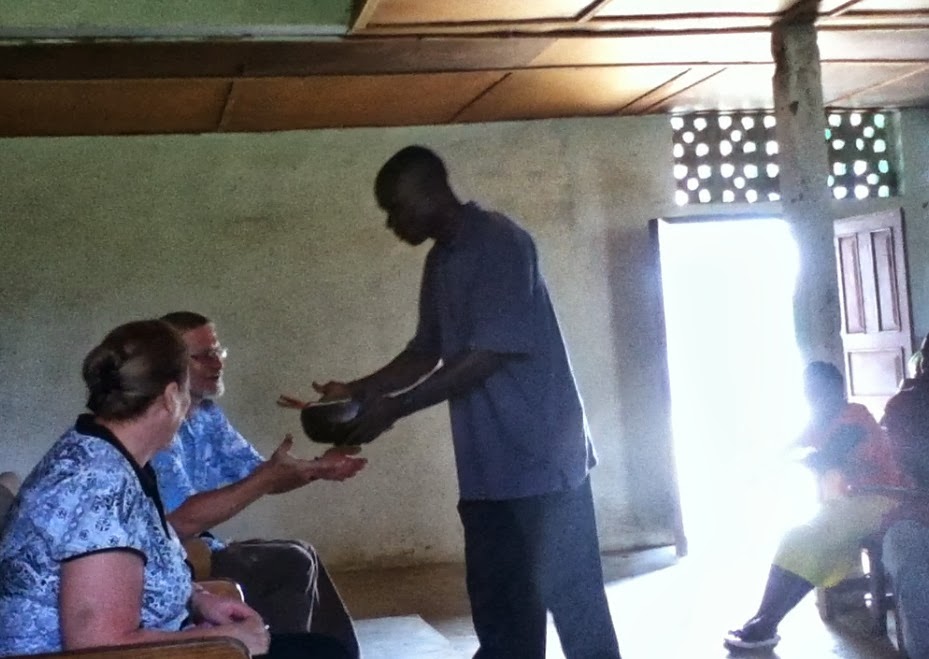
The presentation of the bowl and spoons in Zondo. 2011

Symbols have this ability to make us rethink common things like eating food and they provide us with new and powerful perspectives that can change how we view the world, ourselves, and others. For example, these symbols from Zondo caused me to ask things I wouldn't normally ask myself like, "How do I eat nice with others?", "What does it mean to hang out with friends?", "Is it OK to share a spoon with someone even though my mom said I shouldn't?", and even "How do I say goodbye?"


"Bowl and Spoon" Means What?


To us a bowl and spoon are usually just tools. They aid us in ingesting our Count Chocula or clam chowder. They can be styrofoam or plastic and thrown away. However, upon further investigation we find that we also practice a symbolism of bowl giving in our culture. For example, bowls of china or crystal are often given as gifts at weddings. Why? Because we hope in some small way that the newlyweds will remember us when they use them or look at them. We hope that as they set the table for Thanksgiving perhaps they will remember us and even mention us in a brief prayer like: "God, I hope those guys are doing alright. What nice people."

Perhaps something similar was meant with this Liberia goodbye-gift of Bowl and Spoon. Perhaps it would be best though to hear why they did this in their own words. Fortunately, we videotaped the Bowl and Spoon ceremony at Zondo and had translators who explained to us the meaning of the Bassa words. Here is what giving a Bowl and Spoon mean to the Bassa.


Explaining the meaning of the spoon


Bowl and Spoon in Bassa Tradition


A Bowl and Spoon Presentation


There were two sets of "Bowl and Spoon" handed out to us by the wonderful people of Zondo. Each presentation included a speech. First, the translation of the speech giving in the presentation of the bowl and spoon to my mom and dad:

"Our own Liberian way of telling people goodbye. This is a eating bowl. This is what our fathers used before people began using rubber bowls or manufactured bowls. In our culture we show that we are of one accord, that we have fellowship with one another when we eat together from the same bowl. Your visit to us shows us that you love us and so on your way back we are giving you this bowl. We want you and us to be one family eating from the same bowl.

The spoon also symbolizes something in our own culture. You have your family, your children. You feed your children to grow up to become man and woman tomorrow. As you dish out your food to your children, or to your family, or to your friends, we want you to remember us as you do so when you use this spoon."

My parents receiving their own bowl and spoon set from Zondo

Bowl and Spoon Bassa Speech #2

A second presentation was made from the people of Zondo. To help the following make more sense I was in Zondo by invitation of my childhood friend Floyd Morgan. With that in mind, the following is a translation by my friend Arthur Crusoe:

Arthur Crusoe handing off the bowl and spoons
"Significance of the bowl. We eat together so we will be closely united. Since you came here we are very happy. We don’t have words to express our feelings. Now you are going home. You will want to say, “I have been to Floyd’s home.” So you should have some artifact, some symbol to take with you from Floyd’s home. Our forefathers ate in something like this. Bowl and spoon made of these materials. We are happy. We are happy! Since you are going to your family and when you go and are seated, when you take this spoon and you eat with it, remember us from Floyd’s home. Praise God!"


Remember Me When You Eat

I was a bit confused and nervous when I was asked to respond to the community after receiving these amazing gifts. For one, I don't deserve this royal treatment, and for two, I wasn't quite sure what it meant. I mustered a few words in reply and realized it didn't matter how eloquent I was in response. The people were happy to clap and say 'amen' to just about anything that came from my mouth. They were simply happy I was there. I was happy to be there too and have remembered them often.

Stumbling through some words in a short response speech.

After two years of reflection I realize I have not yet plunged the depths of this Bowl and Spoon symbolism. Perhaps I never will. However, as a Christian this whole concept seems rather at home to my worldview. I mean, who else has said, 'goodbye' through the use of symbols relating to food? For me the words of Christ, 'eat this bread in remembrance of me' and 'drink this cup in remembrance of me', have taken on new meaning because of my Bassa friends. As also His promise that one day we will share in the same cup when He returns. And so remembering is a part of fellowship.  
Sharing bowl and spoons with Zondo brothers

The Power of African Theology

I say all of this to re-emphasize what I hope is being communicating through out all of this blog: we need to hear from Africa. In fact, the whole world suffers when African voices are silenced. Whether they be silenced through wars, disease, poverty, neo-colonial corporatization, or even aid organizations who aren't interested in listening; the fact of the matter is that their silence hurts us all. Their oppression oppresses us all. We all suffer when their voices do not inform us. We need more African theology informing our walk with God. 

Every tongue and tribe?

As Christians we know our holy text tells us that the body of Christ is diverse and made of every tongue and tribe and is therefore not defined by Western traditions, songs, or theological perspectives alone. In practice however we tend to want to use our current positions of power to usurp other traditions, stories, and perspectives. We silence them to our own poverty. 

Who is really oppressed?

In fact, I would say that the church in the States is experiencing a deep poverty of fellowship with Christ as a result of our blindness to other cultures even within our own borders. Like the proverbial Laodicean; we think we are rich, but we are poor. We think we see, but we are blind. We tend to think we know best for Africa and other 'third world' cultures. Yet it may very well be the voice of those that our culture has historically oppressed that can teach us how to finally break free from our own chains. 

I don't desire that we degrade our own perspectives, nor that we adopt everything African, but rather that we include the perspective of our African brethren like they have included us. They have invited us to share the same bowl with them. 

From the mouth of babes

Consider again the children who asked such good questions about the Liberian bowl and spoon. What did they see in these African symbols? I think they can teach us a few things about remembering Christ, considering one another, and true fellowship. Why would anyone do something so strange as give someone a bowl and spoon when they say goodbye? Listen again to the children (and the African wisdom behind it):
"Maybe your friends will get hungry on the way home."
"They may not have bowls and spoons so you want them to have some to eat with."
"So they can remember eating with you."