Monday, July 23, 2012

Liberian Culture on Currency

WHAT'S WHAT ON LIBERIAN CURRENCY

Last post we looked at the front of Liberian bills and were introduced to a "Who's Who On Liberian Currency."  This post flips the bills over and describes the "What's What" on the back of the Liberian bills in current circulation.  Let's start with the L$ 100 bill and work our way back down to the L$5...

Back of a Liberian $100 bill - "Woman At Market"
A Market Under Roof - These designated market spaces under roof
help keep the market from spilling over into the street
and provide shelter from the elements
According to the Central Bank of Liberia the back of the L$100 is a market woman with her child at market.  This is a very common scene in Liberia.  The traditional marketplace in Liberia is dominated by businesswomen.  There are men selling wares at these markets as well, but they usually deal in woodworking, instruments and cinder block (among many other things).  Far and away however, women dominate the Liberian marketplace. 

Market women also hold a special place in Liberia's recent history as it was women praying and singing in a fish market that helped spark Charles Taylor's demise.  Calling themselves "The Women of Liberia Mass Action for Peace" and organized by now Nobel Peace Laureate, Laymah Gbowee, the women successfully united in mind and resources to force change in their war torn Liberia.   These events are described in the award winning documentary, "Pray The Devil Back To Hell", which is definitely worth a viewing.   


Children selling bitterball at market in Liberia
The fact the the L$100 has a women at work with her child also reveals another reality in the marketplace: child labor.  In general this is not the sort of abuse that has been associated with child labor.  More often than not the children assisting their family with the market are treated fairly and hold a place of honor within their family for selling at market.  This is more akin to how life used to be in the US when many families had their children waking up with the rooster crow, milking cows, gathering eggs, helping with harvest, etc.  These children take pride in their work and are happy to pitch in to help.  We'll discuss actual child labor abuse in Liberia a little later...

Back of Liberian $50 bill - Man Harvesting Palm Tree on Palm Plantation
A Palm Nut from a Palm Oil Tree
The back of the L$50 depicts a man harvesting a palm oil tree on a palm tree plantation.  Palm oil is a central part of Liberian life.  Local commerce, cooking, exports and even rituals depend on this tree.  From palm wine to cooking oil to my favorite palm butter; the palm oil tree holds a special place in Liberian society.  In 2009, Sime Darby opened a massive palm oil tree plantation and is currently working on land between Monrovia and Robertsport.  If you take the drive to beautiful Robertsport you'll drive right through it.  If you visit Liberia, be sure to try the palm butter on rice - as they say in Liberia, "Palm butter rice too sweet o yeah!"


Back of Liberian $20 bill - Men with wheelbarrows at market
I'm not sure I understand the significance of the back of the L$20.  The Central Bank of Liberia claims that this is a depiction of a man on a farm.  The picture though is of many men at what appears to be an outdoor market area with a line of wheelbarrows in front of them.  Here is a clearer image of the L$20 than what my iPod camera took.  I am guessing that this signifies the rebuilding of Liberia?  Whatever the case it shows the mostly non-mechanized manner in which much construction is done in Liberia.  Having been in construction for several years myself I was intrigued by the Liberian processes of construction.  I was also impressed by the persistance to build something in difficult circumstances with almost no machinery (just a few hand tools or a wheelbarrow in many cases).    
A pile of "hand made" gravel in Johnsonville, Liberia

For example, this simple pile of rocks I took a picture of during construction of Heart of Grace School in Johnsonville.  Solid rock was first exposed out of the ground on site and then broken in the ground with a sledgehammer.  Why?  In order to have gravel for their cement mix.  What here would have been a simple order of gravel scooped into the back of a truck and dumped on site took weeks to do in Liberia.  Not to mention the fact that their was no eye protection as the men pounded solid rock with sledgehammers.  Several men suffered from rock chips flying into their eyes.  

Here is another example in this video, a school built from trees cut down and milled on the premises (the middle of the bush in Compound 2, GBC).  Again, this would have been a simple trip to the lumber yard over here, but in Liberia nothing is that easy.  These trees were chopped down with hand axes (try that sometime and see how long it takes!) and then sawed into boards with handsaws (again, you might want to see how not easy that is!).  The boards were then carried through the jungle about a mile on rough terrain until arriving at the job site.  In the video the men are applying some sort of tar like substance that will deter termites.  I may not know what the symbolism of the back of the L$20 is exactly, but I know the hard work symbolized by those wheelbarrows!

Back of Liberian $10 bill - Man tapping rubber tree
Rubber is an important part of Liberian history.  Harvey Firestone got tired of paying high prices for rubber for his tires as the British held a monopoly on rubber plantations and fixed prices.  Then he met the financially strapped Republic of Liberia that happened to be right smack in the middle of a prime rubber tree friendly environment.  He negotiated hard and received a concession of 99 years for 1,000,000 acres of Liberia (4% of Liberia!) with exclusive land rights (meaning he could mine for diamonds, gold and take timber and/or rent out to those who did).  He also forced the Liberian government to take a $5million loan from his finance company, which virtually put the Liberian government under Firestone's control.  Needless to say, Liberia as a whole got a raw deal and the US got cheaper tires for their automobiles.  There is a good overview of this deal found here.


An Old Tapped Rubber Tree
Still producing after all these years!

One of the more damning accusations against Firestone concerns labor abuses.  The labor is cheap in Liberia and the daily quota of rubber demanded of workers means that parents often have their children help out to meet the quota.  The nature of this work is very demanding and often dangerous and does seem to me to verge on child labor abuse.  Surprisingly, many Liberians do not see it that way and prefer that outsiders not interfere with their family structures.  This is an all around touchy issue in Liberia.  To learn more from the 'against Firestone' perspective check out this website "Stop Firestone".  For a pro-Firestone perspective, check out Firestone's site.
Soon after snapping this picture of Firestone HQ in Liberia
security guards demanded my mother leave the premises
photo by Carolyn Vogel


In 2011 Firestone was acquitted of child labor abuse in Liberia by a US District Court.  However, an interesting legal precedent was set in that US corporations are now held liable for human rights abuses when committed in another country.  I'm not sure why it took until 2011 to see that it wasn't OK for US corporations to abuse people as long as they weren't in the US when they did it.  

Baby rubber tree being grown by an independent
farmer, in this case an NGO 
Another common commercial structure in Liberia is for independent rubber tree growers to grow, tap and sell their own rubber at substations to the major rubber tree corporations in Liberia (of which Firestone is just one).  This model has caught on like wildfire among Liberians with appropriate land resources and many NGO's are also creating a sustainability plan by using some of their land to grow rubber trees to sell and help fund their humanitarian work.  Several of the NGO's I've worked with in Liberia use this strategy.

Back of a Liberian $5 bill - woman harvesting rice
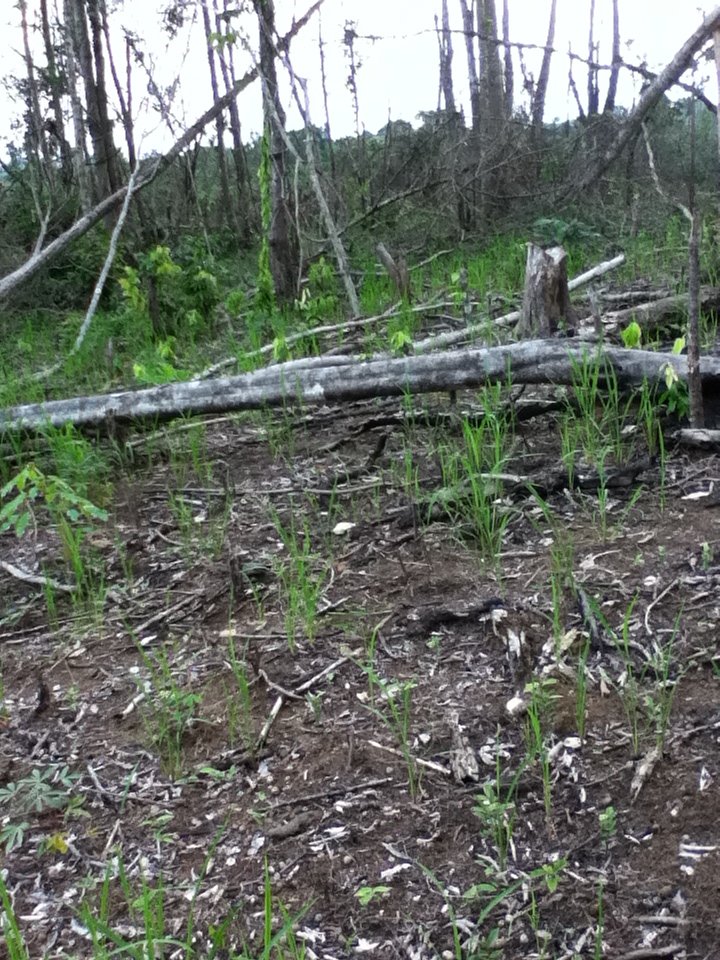
Slash and Burn Rice Farm - Zondobli
Rice is the staple food of Liberia and price changes challenge the entire economic and political infrastructure (i.e. 1979 Rice Riots).  One of the main problems an outsider will see with rice production in Liberia is that it remains at the sustenance level in many communities.  The traditional way of farming rice is the slash and burn method which is highly ineffective, dangerous, nomadic and ecologically damaging.  Liberia is also home to perfectly suited for rice paddy farming, which is a much more productive method of farming rice and helps tie a community closer to their land so that it can be better developed with hospitals, schools and roads.  Good luck convincing any one of this though!  Liberian slash and burn rice farming is deeply steeped in their culture.  Communities exchange intrinsic currencies like trustworthiness, hard work, status and respect by assisting each other in their complex system of traditional rice farming.  Rituals, dances, magic, commerce, relationships and of course food are all a part of these traditions and time after time Agricultural NGO's have beat their head against the wall trying to change these ways.  These patterns don't seem likely to change any time soon.


Bowl of Rice with Greens - Yum!
When in Liberia see if you can get some good whole grain country rice.  Be careful as there will probably still be rocks and chaff in the mix, but the taste is outstanding.  Whether you get some of this rice or not you will be offered rice to eat!  Rice is everywhere and is usually topped with an amazing array of different sauces and soups poured over them: collard greens, potatoe greens, bitter ball, palm butter, pepper soup, cassava greens, pumpkin (which is actually what we would call squash); these are just a few of the main toppings for rice.  Meats of all sort are sometimes added to these toppings as well as some good old fashioned hot pepper!  

Here comes the end of the Liberian currency overview as they do not have a Liberian $1 bill.  For an up to date rate of exchange with the USD check out this converter at XE.


Sunday, July 22, 2012

Liberian History On Currency

A lot can be learned about Liberia's past (and present) by observing what is printed on her currency; the Liberian Dollar (LRD).  Even before the LRD, Liberia has had a very respectable reputation in world numismatics due to its unique contribution: the Kissi Penny.  The Republic has gone through several major transitions with its currency especially during the social unrest of the past 30 years.  For example, when we lived there in the 80's Samuel Doe minted so many $5 coins (app. 6 million in 82 & 85 for a poverty stricken population of 2.5 million) that he created inflation problems and the coins became known as "Doe Nickels".   During the Civil Wars there were certain militarized zones where "J.J.'s" were used (so-called because they bore the image of the 1st Liberian president J.J. Roberts (see below; $10 LRD)) and other areas of Liberia where "Liberties" were used (so-called because they replaced J.J's image with Liberia's coat of arms).

Today the US Dollar (USD) is used in Liberia alongside the LRD with a few interesting side notes: 1) For whatever reason if your bill has a tear on it it will not be accepted by many vendors, so only bring crisp bills. (we had great difficulty getting someone to take an otherwise fine $20 bill with a slight tear on the corner).  2) Again for some strange reason the $1 USD bills are not considered to be at the exchange rate (currently $75 LRD = $1 USD).  They are not accepted the same way as other US currency, which means you can't buy as much with 5 (five) $1 bills as you can with 1 (one) $5 bill.  This is difficult to explain but in short: unload the $1 bills you do get in change for tipping and bring bills larger than $1 USD for spending.  Perhaps the reason for this downgrade on the USD $1 bill is because the Liberian currency does not have a $1 bill, but rather starts at $5 LRD.   Let's start by taking a look at this bill that is used today in Liberia and hopefully learn a bit about Liberian history from Liberian currency...

WHO'S WHO ON LIBERIAN CURRENCY

Front of the Liberian $5 bill

President Edward James Roye (1815 - 1872) is on the front of Liberia's $5 bill.  He became the 5th president of Liberia in 1870 and was also Liberia's 4th Chief Justice before taking the role of President.  With him began the dominance of the True Whig Party over Liberian politics that did not end until Tolbert (see below) who was assassinated in 1980.  Only one other president (James Spriggs Payne) was voted into office from another party during that time frame and he only served from 1876 - 1878.  Of interest to US citizens was that Mr. Roye was actually born in Ohio and was a graduate of Ohio University!  In 1846 he heard about the ACS initiative to send free people of color back to Africa and he saw an opportunity and immigrated to Liberia.  When he was elected as president, the fledgling Republic of Liberia faced an economic crisis.  Roye tried to fix this by obtaining a loan from Great Britain which ended up actually making matters worse.  He was deposed as president and jailed shortly after and died a mysterious death in early 1872 (either drowned, shot or beaten to death depending on the report).  One bit of lore is that he was beaten to death and his nude corpse was paraded through the streets of Monrovia, an act that would be replicated with future presidents of Liberia (see Tolbert & Doe below).

Front of Liberian $10 bill

Joseph Jenkins Robert (1809 - 1876), commonly known as J. J.,  is one of the more famous Liberians presidents and one you should know about if you plan on visiting Liberia.  He was both Liberia's 1st President (1848 - 1856) and 7th President (1872 - 1876) and between presidencies he served as a Major General in Liberia's army, a diplomat in France and England, and helped found Liberia College (later to become the University of Liberia).  Like President Roye he was also born in the US; in Norfolk, VA.   He actually had mostly European ancestry and some historians refer to him as an 'octoroon' (1/8th black).  He supposedly immigrated to modern day Liberia in 1829 with hopes of evangelizing the indigenous peoples with Christianity.  Before becoming president he served as Liberia's first black Governor (following the white Liberian Governor Thomas Buchanan; a relative of US President James Buchanan).  Later, as Liberia's first head of state, he traveled extensively introducing the new Republic to such dignitaries as Queen Victoria.  Liberia was officially recognized by Britain in 1848 followed by many of the other world powers with the conspicuous lone hold out of the United States.  It wasn't until the days of President Abraham Lincoln that the US would recognize Liberia as a nation during her own Civil War in 1862.  One wonders if this was simply a political move by Lincoln, although Lincoln was a long time proponent of sending African American Freedmen to their own colony (he preferred Central and South America).  During Jenkin's presidencies Liberia's land was expanded to include the territory of the Republic of Maryland (named after the US state of Maryland) and the infant nation garnered international recognition.  Today, Liberia's main airport (Roberts International Airport) is named after him along with the town of Robertsport and Robert's Street in the capital city of Monrovia. His birthday (March 15th) is celebrated as a national holiday to this day.    

Front of Liberian $20 bill
William Vacanarat Shadrach Tubman (1895 - 1971) was Liberia's 19th and possibly most influential president.  He held the position of president for an amazingly long time (1944 - 1971) and oversaw many changes in Liberia through his Open Door Policy.  While his parents were immigrants from the US and thus part of the ruling Americo-Liberian elite, he himself was born in Liberia and attempted to bridge the deep divide between the indigenous peoples and the Americo-Liberians by casting himself in the role of defender of the rights of the people of Liberia's "Hinterland" (interior forested regions).  He called himself "The Convivial Cannibal from the Downcoast Hinterlands" which I suppose would somehow identify him with the Liberian assumption that those in power have engaged in ritualistic cannibalism to secure their positions.  I hate to use the pun, but perhaps he was only being tongue in cheek?  I don't know, but whatever the case he ruled over Liberia as some sort of father figure verging on being an object of worship.  Everyone's paycheck and livelihood seemed to have come from him in some way and he effectively ruled over executive, legislative and judiciary branches with his system of cronyism.  During his presidency Liberia prospered beyond belief for such a tiny nation, although only a relative few would benefit from the gushing funds flowing in, particularly Tubman himself.  Some believe that when Tubman died in 1971 he was the richest man in all of Africa.  Under Tubman Liberia had the world's largest mercantile fleet, the world's largest rubber industry, and was the 3rd largest exporter of iron ore.  However, the people mostly remained in poverty and the infrastructure of the country did not benefit from this economic growth.  The rich kept the wealth to themselves and the suffering of the people reached the boiling point of the 1980 coup and then all out uncivil war in 1990 - 2003.  Tubman gave Liberia prestige and showed the world her true potential.  Too bad, he kept most of it for himself.  

Front of Liberian $50 bill
(equal to less than $1 US)
Samuel Kanyon Doe (1951 - 1990) helped lead the overthrow of the True Whig Party in 1980 when then president Tolbert was assassinated by a group of 17 Liberian soldiers that included then Master Sergeant Doe.   He was the first president of Liberia not to be descended from US slaves (Americo-Liberians) having come from various lineages in what is called the Krahn tribe (see The People Groups of Liberia).  At first the Liberian people rejoiced at this "Country" man who had overthrown the "Congo" man. ('Country' is slang for indigenous and 'Congo' for Americo-Liberian)  Their joy did not last long.  I lived in Liberia when he was "elected" in 1985 after numerous opposing candidates "disappeared" and Doe's handpicked ballot counters took the ballots to a secret location to determine the outcome.  The feeling on the street was that his opponent Jackson Doe (no relation) was the actual winner.  People were furious and the next month, Thomas Quiwonkpa (who was one of the 17 that had originally helped Doe in the overthrow of Tolbert), staged a coup attempt against Doe.  (Quiwonkpa was the founder of the NPFL which was later led by the now infamous Charles Taylor.)  I remember the day of this coup attempt clearly as our home was invaded by Doe's soldiers in order to confiscate my dad's ham radio.  There was widespread suspicion that the US was aiding in this overthrow attempt just as Doe was supposedly aided by the CIA in his overthrow of Tolbert.  (The fact that CIA West African HQ's were in Monrovia, Liberia probably helped advance this theory.)  I remember listening to the radio and hearing Quiwonkpa announce from the recently captured radio station that he was now the Commander in Chief and he was firmly in control.  Problem was that he only had control of the radio station and there was still gunfire to be heard in the background! However, many people ran out into the streets shouting and dancing for joy that Doe was gone.  Doe quickly put down the coup attempt and supposedly ritualistically cannibalized Quiwonkpa.  His nude corpse was displayed in Monrovia and some civilians who had been identified by others as having danced at the news of Doe's defeat were executed.  Doe went hard after Quiwonkpa's ethnic Gio tribe and many were massacred (this helped Charles Taylor gain many Gio and Mano soldiers in his later coup attempt against Doe).  The mood in the nation went dark in 1985 and there were curfews announced on the radio with Doe himself saying that anyone seen outside after dark would be "shot on the spot!".  Checkpoints went up all along the roads and we were often stopped by underpaid or unpaid soldiers armed with Uzi's asking for identification (among other things).  Doe was uneducated but he had enough wits about him to receive millions of dollars in US aide for his support of the US in the Cold War.  He was able to hold onto power until Charles Taylor invaded in 1989, sparking the darkest period of Liberian history.  He was tortured and murdered and supposedly ritualistically cannibalized by Prince Johnson (one of Charles Taylor's rouge generals and current Liberian Senator for Nimba County).  This event was actually recorded by a Palestinian reporter who was covering the coup attempt and can be seen below (warning: graphic).  Today Doe is honored as one who brought down the stranglehold of the Americo-Liberians upon the indigenous people of Liberia.  Samuel K. Doe stadium near Monrovia is named in honor of him.


WARNING: GRAPHIC VIOLENCE
View with discretion

Front of the Liberian $100 bill
(roughly equal to $1.33 USD)
William Richard Tolbert (1913 - 1980) was the 20th president of Liberia and the last President from the True Whig Party.  He was president when I lived in Liberia as a small child, but I don't remember much from those days except eating bug a bugs and playing in the rain and on the beach.  He followed after Tubman's amazing economic growth (see above), but also inherited a structure in which the country was not developed for the good of all.  He was an extremely intelligent man and seemed to desire greater equity for the people of Liberia, the problem was that there were too many people in power benefiting from the status quo and he upset too many people.  It seems to me that he lost protection from the system by trying to change it and became a target because he tried to think outside of the box.  Some have even speculated that his favorable relations with countries hostile to US foreign policy during the Cold War era even made him an enemy of the US.  There have been speculations and testimonies that his assassination in 1980 was masterminded by the CIA.  This doesn't seem to make much sense to me and whatever the case, there was not much of a master plan behind this chaotic coup that wasn't even organized enough to elect another president for another 5 years (Doe; see above).  He is most infamously remembered for instigating the Rice Riots of 1979 in which his cabinet raised subsidized rice prices apparently for his benefit under the guise of controlling overpopulation in the city by giving people incentive to stay on the farm and grow rice.  Seeing as Tolbert was known for being sympathetic to socialist schemes (i.e. subsidizing and population control) that guise might have been true, however he owned large rice farms in Liberia so the fact that he would benefit was also true.  Just one year after these Rice Riots Tolbert was assassinated and his cabinet executed on a beach in Monrovia.  Tolbert was an original leader with a sharp intellect although not as widely honored throughout Liberia as Roberts and Tubman.  His reign is still remembered by the older generation.

In the next post I will turn these bills over so that you can get a "What's What" of Liberian culture as depicted on the back of Liberian currency.


Saturday, June 16, 2012

Societies Within Society - The Secret Societies of Liberia

You will come into contact with Secret Societies if you stay long in Liberia.  You will hear all sorts of things about them both good and bad.  You will probably see all sorts of evidence of them, like the masked and raffia dressed man I witnessed last summer dancing in the Monrovia streets on 10 foot stilts.  If you desire to better understand the complex picture painted by Liberian culture it is essential to have a basic introduction to these societies.  


A 'Bush Girl' - the white chalk paint can symbolize many things including an 'in-between' phase before her graduation when she is considered a kind of walking dead. 


Poro and Sande

First off there are two main societies: Poro and Sande.  Poro is the society for men, Sande for women.  There are many other societies as well, but these are the main traditional societies (for example, the Krahn that have a society more like those of Ivory Coast, and the Masonic Order which functioned in Liberia as a kind of secret society among Americo-Liberians yet rumored to have practiced ritual sacrifices just like Poro).  Within Poro and Sande there are sub-groups that are designed for certain strata of society: chief, Zoe (pronounced "Zoh" meaning priest), and the regular ordinary initiate.  


Poro and Sande have held a great amount of power in Liberian society and in many cases they still do.  I have heard the rumor on several occasions that no one can hold a political position in Liberia without being a member of Poro or Sande.  I'm not sure that is true, but that sentiment is easy to find in Liberia. 


Citizenship by Initiation

What is fairly well documented is that many traditional communities do not consider the uninitiated to be a citizen of their village, clan, or even tribe.  The uninitiated are considered 'unclean', 'childish' and/or unfit for marriage until they have been initiated (this usually involves circumcision).  Therefore, the advantages to joining are so great that many parents are eager to place their child in 'bush school' during enrollment season.  


Forced Enrollment

Because the price for putting your child in bush school can be expensive for the poorer members of the community a controversial practice has arisen: 'forced initiation' or 'forced enrollment'.

From what I've been told, 'forced enrollment' used to occur on a certain day of enrollment season, after the formal enrollment and dues had been paid by other students (usually some chickens, rice, palm wine, kola nuts, or some other form of currency). 


The Day of Kidnapping

On this one particular day the masked school master(s) would roam through the village and "kidnap" any child they found out of his or her hut.  This 'kidnapping' was understood as a way for those in the community without sufficient funds to get their child into bush school so their child could be a respectable citizen of society.  

Parents understood that if they could not pay the enrollment dues they could leave their child outside of the hut on that day and they would be grabbed and taken to the secret location for initiation. 

Even today there are certain places where one is advised to not travel at certain times because the society will attempt to kidnap travelers and perform their initiation rituals upon them even if they have no intention of joining!  


Female Genital Mutilation

Just last summer there was a case in Liberian court about a girl who had been unwillingly taken by a society and forced to undergo female circumcision, which brings up another controversial practice: deemed FGM 'female genital mutilation' by its opponents, and about which I'd prefer not to elaborate except to say that the US DoS estimates 50% of Liberian women have undergone this sort of procedure.


This location for this bush school is not well hidden and often times they are not.  The palm woven walls around the meeting place is a barrier to non-initiates and should not be crossed. Trails in the bush leading to even more secluded spots are even more forbidden and should be avoided.


Benefits of Poro and Sande?

I've already introduced several controversial aspects of the societies, what about the good things advocates claim they do for Liberia?  Well, the publicly stated purpose of these societies is to instill a cultural norm for the community.  

For example, in bush school the initiates are taught their cultural history, folklore, and customs.  They are taught to respect their elders and how to perform certain tasks within the community.  While this model of generational wilderness school is not necessarily a bad model for teaching you will find the controversies have not been about the model of teaching per se, as much as they have been about what is taught in them and what is done to the students (see FGM above).


My sisters at a village in the Liberian bush.  Notice the two girls with white chalk faces - I was told they were in bush school and on leave to help out with the chores until the next session.


Secret Keeping

What exactly is taught in the secret society bush schools?  Well, it is called a secret society for a reason!  One of the things that is apparently taught is how to keep secrets.  Seriously.  

Secret keeping is highly valued in Liberian culture.  Many Liberians know what goes on behind closed doors, but not many are vocal about these things and consider that secret keeping to be a virtue. 


Bush School Curriculum

What has slipped out about bush school curriculum through the years is that there are various stories and songs and drum beats and dance steps and secret words taught in these ceremonies in the bush.  

One man revealed that all he did after his circumcision was go back into the 'sacred grove' and eat rice and hear a few stories and then he went home the same day initiated.  Perhaps he was kept at the lowest level of initiation because the society knew that he wasn't one for keeping secrets!  


What you are taught there also seems to depend on how much money you pay the teachers, how long you go, what tribe you are with, who your teachers are, and what caste you belong to among several other factors.  There also appears to be levels or degrees of initiates and different lessons for different occupations like hunter, herbalist, farmer, chief, zoe, etc.


The Bush Devil
and
Secret Societies


Bush girls seen from a taxi seem just as curious in us
You also need to be aware that the term 'devil' is commonly heard in Liberia concerning secret societies.  The man I saw last summer dancing on stilts and wearing a mask would have been called a 'devil'.  


Origin of the term

This is a term that is carried over from the old days of Christian missionaries to Liberia and Sierra Leone who called these masked, dancing people 'possessed by the devil'.  This interpretation would make sense to a Christian worldview as the mask is viewed by these communities as having a spirit that needs "fed" (more on that later) and the ability to transform its wearer into another being.  


The Devil Bush

This terminology has also carried over to the sacred grove where the bush school takes place.  These areas are commonly called 'Devil Bush' in the common Liberian vernacular.  One is forbidden to enter a 'devil bush' without being invited and this was at one time punishable by death.  I'm not interested in seeing if this law is still in practice and if I were to see a spot marked in the jungle (usually with palm branches making an archway near the entrance or a hanging medicine bag) I would avoid it.


Video of a Krahn 'Devil' visiting a community. The Krahn have a similar secret society but seem
to be distinct from Poro and more akin to Ivorian socities.


Secret Societies 
and the Civil War


You will meet people in Liberia that believe that the cause of all of Liberia's problems are because they have neglected the ancient ways of Poro and Sande and the Divine Spirit of these societies is punishing them.  You will also meet people who say that God allowed Liberia to suffer because of the atrocities that take place in these societies and the sooner they are eradicated the better for everyone.  

Whatever the position one takes, the recent Civil Wars in Liberia revealed just how easy it can be for these secret societies to be hijacked and for devastating effect.  Children were often 'initiated' into various paramilitary societies and asked to perform rites of passage (i.e. atrocities which were often under the influence of drugs and alcohol).  These young soldiers were also seen wearing 'masks' such as wigs, bridal dresses, and actual Western Halloween masks while performing their deeds of war.  The warlords became the new chiefs and Zoes and the law was to follow them.  


Condemned Secret Societies
(Neegee and Human Leopards)

However, this hijacking of the traditional societies is not a recent development. There have been outbreaks of this sort of obscene violence and barbarism before: for example the Human Leopard Society

Poro and Sande both publically agree that the Human Leopard Society is an evil secret society.  This group and also the Neegee Society ('neegee' is the Bassa word for crocodile; literally "water leopard") are both openly condemned by Poro and Sande. Some hold that this public condemnation is only spin and that Poro is more than ready to practice human sacrifice when stronger power is needed.  


Feeding the Fetish

Societies like the Neegee are known to prey on humans to feed their 'fetish' (usually a carved wooden or waxen image of the spirit of their society).  This fetish-god is attended to by its Zoe (priest) and so it is the Neegee Zoe who knows the rituals for both placating the spirit of the leopard and for gaining power from this spirit.  One of the powers they are said to obtain from this spirit is the ability to transform, werewolf like, into a leopard or water-leopard (crocodile).


Ritualistic Murder and Cannibalism

The Neegee society is also notorious for ritualistically murdering their victims and making it look like a leopard or crocodile attack.  The tell-tale signs of the ritualistic murder however is that certain body parts are missing from the victim.  

These body parts are esteemed for their purported ability to instill specific powers in the person who eats them under the proper guidance of the Zoe.  Part of that ceremony seems to involve the fetish-god being fed some of the victim's blood and fat.  Once that spirit is satisfied then the initiates eat specific body parts for specific powers themselves.  The distribution of these body parts is usually determined by the rank of the members with the highest ranking getting the choice parts.   


Poro, Sande, and Ritualistic Murder?

While the Neegee Society is known for this ritualistic cannibalism, it has been assumed by some that Poro and Sande also historically engaged in these sort of practices.  This could stem from the fact that new initiates are described as having been eaten by the society spirit while in the devil bush. 


Scarification

 Part of this process does indeed involve scarification (which are interpreted as 'teeth marks') being made upon the initiate to show that he has been eaten by the spirit, which is the necessary precursor to being 'reborn' into society as a true citizen of the community.  You will see many people in Liberia with this sort of scarification.  They will as a rule not talk about these marks if you bring this up for discussion.


A 'Devil' on stilts - similar to the one I saw from my taxi in Monrovia last summer.


Conclusion


As I continue on with this survey I realize how much this only scratches the surface.  I haven't even touched on masks, the taboo laws, animal spirit guides, graduation ceremonies, markings, amulets, sassywood ordeals, carved stools, staffs, degrees, transmigration of souls, lightning manipulation, medicine huts, juju, et al.  

T. J. Aldridge photo of Poro Tassos (priests) in nearby Sierra Leone, 1901, Cambridge University Library

There are books upon books written about these sorts of things and let it just suffice to say that the impact of secret societies upon Liberian culture is widespread and pervasive beyond what these few paragraphs can illuminate.  Perhaps I will write more on this subject in the future, but for now just be aware that there is a culture in Liberia that lies beneath the culture and one can feel that it is there.