Tuesday, July 30, 2013

Breakfast in Liberia


Liberian pineapple would rival any worldwide!
There are a great many options when it comes to the first meal of the day in Liberia. The Lone Star Republic offers some of the best pineapple in the world, also banana, mango, and oranges; actually the list of great fruit options goes on and on... There are also specialty breakfast dishes like "moe nee kalah mah" (the ready-made Mandingo inspired breakfast in a bag) and farina that are definitely worth trying. Today I want to share my two favorite Liberian breakfast dishes: Gaaree and/or Calla.


Garee

A packet of 'Gaaree" straight from market and ready to prep for breakfast


A nice spot to enjoy breakfast!
What is gaaree? Gaaree is yet another Liberian dish made from the cassava plant (see fufu and dumboy). Gaaree is made by grinding the cassava root into a coarse flour and then drying. They are often sold in little plastic bags on the street. 

Here is what I do with that bag of gaaree: add hot water, a few scoops of Nido (my favorite of the powdered milk options; which are used since milk is practically non-existent in Liberia), and sugar to taste; all going into a bowl and then stirred. Note: depending on how the gaaree is dried it may take some getting used to. Often it is dried over a fire and leaves a smoky taste that is not one that you may desire first thing in the morning. I've gotten used to it, but it is a little intense for breakfast. Indirect heat drying will leave you with a delicious flavor that resembles a hearty cream of wheat sort of experience.


Calla frying in boiling oil... the smell is divine!

Calla

By far my favorite breakfast is about 3 - 7 warm calla (depending on the size). Calla are made out of some sort dough that is a cross between a doughnut and a funnel cake. It is formed into balls and dropped into a pot of boiling oil. You have two main kinds of calla: red oil calla and argo calla. These names derive from whatever oil they are deep fried in: red palm oil or vegetable oil (argo). I like them covered in granulated sugar while still hot out of the oil. A great breakfast treat! My mouth still waters whenever I think of the market caller singing: "Swee kah lah! Geh yah swee kah lah!" 


...Can't forget about the coffee!...


Sweet Calla is served!  I think I could
finish this bowl full no prob :-)
To wrap up: I enjoy both of these meals with a cup of hot coffee. Due to lack of electricity you will usually be making this with hot water from the charcoal stove and a french press or instant coffee. Coffee snobs may actually enjoy the french press process and might want to try to find Liberia's very own indigenous coffee (coffea liberica). Another option is Starbuck's Via packets which are known to create a nice cup of coffee. I actually found the local market offers a "3 in 1 instant coffee" packet that really isn't all that bad! My people, I tell you.... Nothing beats sipping a cup of hot coffee and filling up on gaaree and/or calla while there is a nice Liberian rain starting outside and beating on the "zinc" overhead.  :-)


Coffee, Nido, and mango while we wait for calla.


Saturday, July 27, 2013

The Richest Man In Africa: Inside His Mansion

Portrait of William Tubman
Portrait of President William Tubman displayed in his mansion near Totota, Liberia

Liberian President William V.S. Tubman was once considered by some to be the richest man in all of Africa. Who knows how much money he actually had, but when he died in 1971 his known assets were equivalent to $1.3 billion in today's dollars.  In a nation that today averages app. $1000 in annual income he was by all comparisons one of the super rich in his neck of the woods.  However, it is this comparison that leaves many wondering, "what is his true legacy?" and even "what could have been in Liberia?"  There is a lesson in President Tubman's life for all of us and I believe it asks us, "Will we leave behind a better place or try to take it all now for ourselves no matter the consequences to others?"


Plaque welcoming visitors to William Tubman Museum
Plaque outside the old Tubman residence stating 'W.V.S. Tubman Museum
Tubman's birth and death dates are given as well.

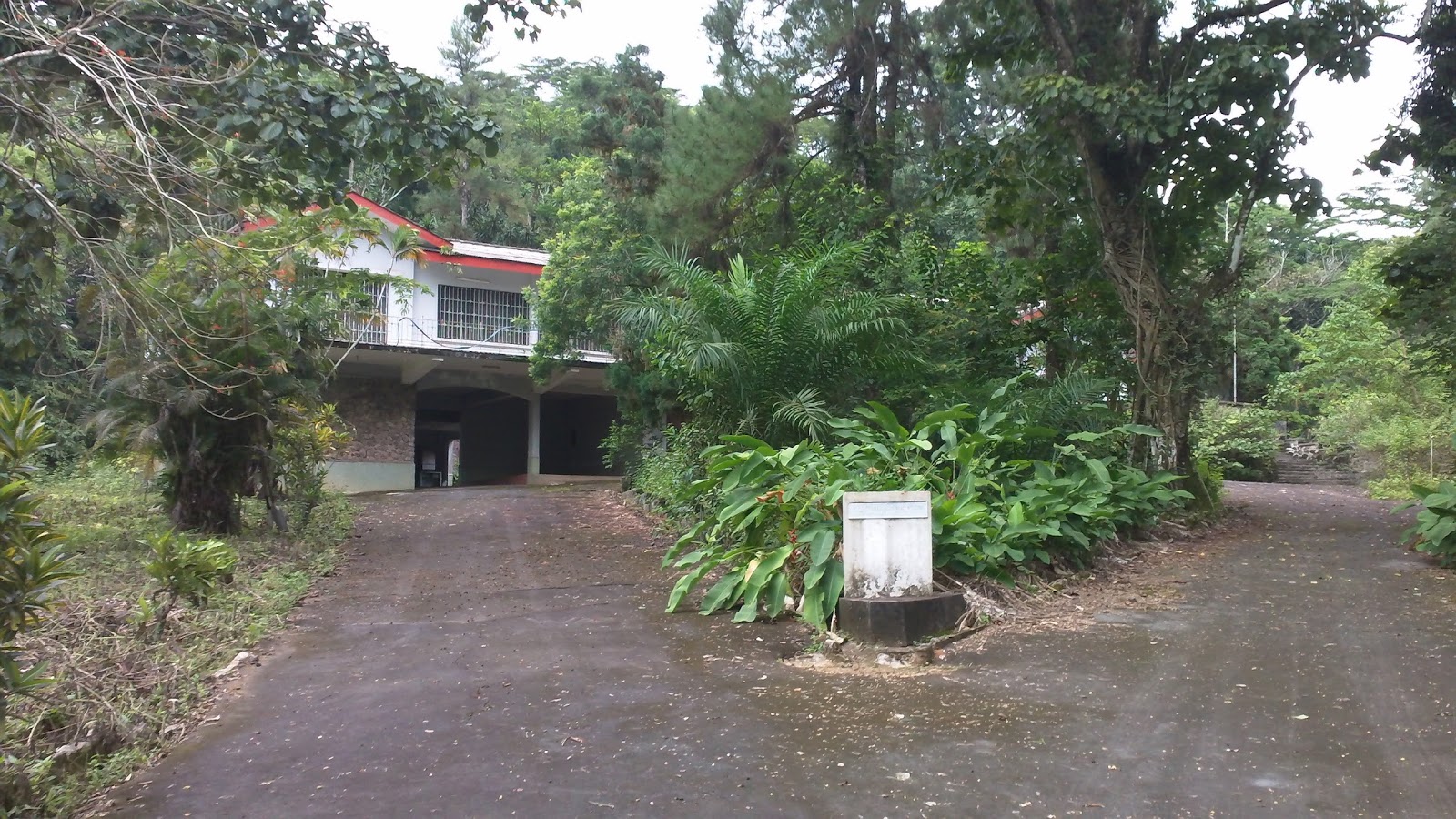
Today I want to show you some of what President Tubman left behind. His now abandoned mansion near Totota was a place I remember visiting as a small child in 1976 or 77. There was a zoo there that was managed by the Tubman family. However, sometime in the late 70's the animals were shipped out to Ivory Coast before Tubman's successor, William Tolbert, was assassinated by Samuel Doe and his cronies. This is contrary to the popular belief that rebels ate all the animals in the zoo during the Civil Wars.


The now empty bird cage that once housed birds during zoo days.


What is left of a stuffed lion
guards an entrance to the
Tubman mansion
During the Civil Wars, rebels loyal to Charles Taylor made headquarters here at the Tubman mansion and Taylor even kept a pair of lions gifted him by the president of Niger on these premises. One interesting story about this is that during one long stint of fighting the rebels were not able to feed the lions for 25 days and the male lion died. The lioness was slowly nursed back to health and eventually UN workers came on site and tranquilized her and took her to South Africa. Today she supposedly is doing well and has even had a cub since moving.


Remains of a stuffed, headless lion guards the Tubman mansion

Today some of the Tubman family still come by and visits but no one lives there. There is even a Tubman cousin that remains  in the area 'managing' the property as best as can be without the needed funds to keep it properly maintained. He reports that today's President Ellen has even stopped by the Coo-Coo Nest, but she has not crossed the street to visit the old mansion. She did however ask about it's condition. 


Climbing the stairs to the side entrance of the Tubman mansion

The mansion's condition is that it simply sits on the edge of the jungle slowly decaying. The day I visited a 'rouge' had pried open one of the doors the night before and had entered in, probably to find shelter and/or look around for things to take. There is not much left to take after years of looting. I also recall having to duck several times as a bat swooped down close over head. It would seem that now these presidential premises are left to be inhabited by thieves, rats and bats. And so this is the legacy of a president bent on increasing his wealth at the expense of his nation.


These dusty display cases used to be filled with artifacts of Tubman's presidency that have long since been looted


Stairwell inside the Tubman mansion
Liberia by all accounts should be one of the richest nations in the world per capita. The natural resources are off the charts (gold, diamonds, iron ore, timber, rubber, palm oil, crude oil, etc.). The entire population of the Republic is only the size of mid-level US city. Had Tubman developed Liberian infrastructure and trained Liberians with skills, today Liberia would be flourishing and perhaps the now extinguished eternal flame on his grave site might still be burning. This mansion in the jungle would be maintained as a museum honoring a great giver who lifted up Liberia. Instead it beckons those who would seek power in Liberia to come and visit and see.  Look around at this transient 'glory' and hear the question, "Who wants to do this next? Who wants to leave a pile of neglected and decaying rubble in the jungle?" This is Tubman's legacy, but I hope there are better legacies yet to be left for the wonderful people of Liberia. 


The faux ivory tusks at the driveway entrance to the Tubman mansion is now used as a taxi stop


What is left of a beautiful piece of furniture sits exposed to the tropical humidity and rots

A hallway full of empty display cases


A beautiful table frame sans table top

One of the pieces of a cow horn furniture set given to President Tubman by the president of Kenya

Where Tubman slept

Where Tubman pooped

Beautiful desk near the bedroom at the end of the hall

The trophy room holds nothing

More empty trophy cases lining the halls

Not your typical Liberian light fixture.

What is left of Tubman's personal library located in the basement. Notes housed at Indiana University state that this library once contained 1202 books.  It doesn't look like the rebels stole too many -- perhaps they weren't given to much reading?

This stuffed flamingo looking creature was the library decoration

Close up of what Tubman liked to read

The trophy case hallway with lion at the end


Carving next to Kenyan cow horn furniture in Tubman's private meeting room

One of the few trophies remaining.
There was also a letter from Nixon's office on display but my flash washed out the image :-(

A beautifully carved desk with Africana and a family (?) portrait. Not sure if this is Tubman's mother or Harriet Tubman the famous freer of slaves in the US that president Tubman claimed relation to.

A couple of busts in Tubman's private meeting room.

Heading back downstairs from the meeting room


The trophy head guarding the stairway

The Tubman monogram logo that emblazoned the stairwell guardrail system


Appears that he had central air

The front door

The generator that powered the mansion. Rebels stole needed parts from it during the Civil War
Looking down to the elephant tusk gate from the driveway


Viewing the mansion from the driveway. Tennis courts are to the right just out of view


Walking up the drive


Another empty trophy case


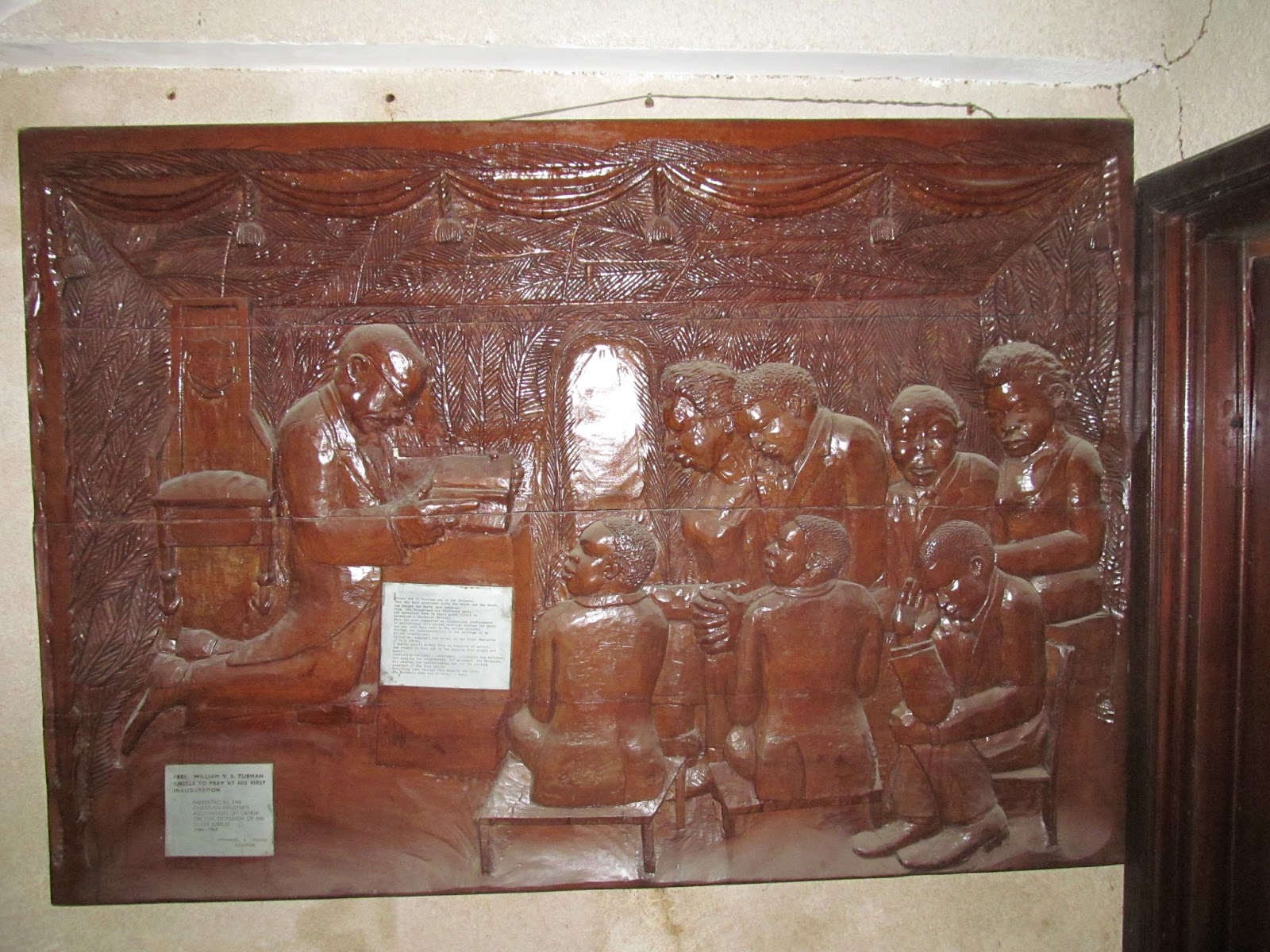
Tubman with Liberian pastors praying -- nice PR

United Beh Mah Association One Cent Certificate

It appears Tubman was a 33 degree Mason.
This plaque was in his private meeting room.

A few carvings on the marble floor of Tubman's private meeting room
There was a kitchen with service window to the right


Author with our tour guide Alex Tubman (President Tubman's 2nd cousin and property manager)
Alex was great to talk with and a wonderful guide!


Monday, July 22, 2013

How to Throw Hand Signs in Monrovia

In the greater Monrovia area you will notice people on the side of the road waving at taxis and buses in strange ways that resemble karate chops or athletes celebrating a home run.  What may appear to just be strange or random behavior is anything but. Upon further investigation you will discover that each particular wave or gesture has a particular meaning attached to it.  They have to do with communicating your desired destination to passing taxi drivers. I've posted a few pics here to help you decipher some of the most common hand signals used in the Monrovia area for hailing a cab...

If you are on Broad Street and make this signal it means you want a ride to Red Light Market.  If you are at Red Light Market it means you want a ride to Broad Street.

If you are at Red Light Market this signal means you want to go half way --- meaning you want to go to Duport Raod or ELWA Junction.  Sometimes you will also see people moving  their finger around in a circle when making this sign. 

This is one of my favorite signs as it means you want a ride to the Airport (RIA) --  makes sense!  However, you must be on Broad Street for it to mean you want a ride to Robertsfield.Airport, otherwise this sign simply means you want a ride to a place nearby.  When the taxi pulls over you state your desired destination and he'll tell you whether you can take you now or not.

This signal means you are going to the Old Road or surrounding community, that is if you are making this sign while at the ELWA Junction.
 However the best way to get a taxi in Liberia is to go to one of the main taxi stations (where you see all the taxis gathered together).  There are several of these stations at main destinations like Red Light, Duwala, Robertsfield, etc.  When at a station you can actually "charter" the whole taxi so that the driver won't stop to pick up anyone else alongside the road making this signs.  It is not uncommon for taxis to cram seven people into one small 5 passenger car and believe me if you thought it was hot in Liberia before this happens, you ain't seen nothing yet! 

You going Old Road?
So next time you're cruising around Monrovia and see people waving and pointing in all sorts of peculiar ways, you'll have a better idea of what is being communicated. Until then... you going Old Road way my man?