Thursday, July 4, 2013

Join Me In A Liberian Parade!


Ready for the start of the LCHS Homecoming Parade through Buchanan
----------------------

Complete with brass band!
Happy 4th of July!  In keeping with the festive spirit of the day I invite you to join me for a few fun filled moments in a parade through Buchanan, Liberia.  We were recently invited to join a parade through the streets of Buchanan by the Liberia Christian High School Alumni Association.  For you Bucktown people... The parade began on Tubman street near the old Welcome Sign (which has apparently been temporarily removed until road & sidewalk construction is complete); It continued to the main Market road and then went by the old Army Barracks all the way to Liberia Christian High School.  Quite a hike!


One of the Standard Bearers getting ready to march with the LCHS Banner

The parade was in celebration of the LCHS Homecoming.   There was a Homecoming Queen, speeches, a small brass band, a confrontation with a peen peen driver, a rain storm, dancing children, marching, chants, banners, food, singing, and an overall amazing Liberian experience.  Let the pictures, captions, and videos tell the story...


The Parade begins:


...And the band begins to play...

...On Tubman Street...

The streets remained active during the parade!  I wonder if they got their city permit?

Nasser's Supermarket on Tubman where I used to get comics and candy as a kid is still in operation after all these years!

Gas Station on the side of Tubman --- Notice that parts of Buchanan now have sidewalks!

Students from Bassa High School enjoyed the parade as well.

Parade on Tubman -- Notice the newly paved roads complete with dividing lines that were actually sometimes even used!

The interaction with the people on the street was mostly yelling hello and people dancing to the music and/or saluting

A Congo-style house in Buchanan on the Parade route


....And then came the rain!!!


The guy leading a lot of the underclassmen chants and songs asked me to take his picture

St. Mary's Catholic Church in Buchanan

Off Tubman Street the roads are back to washed out dirt roads


...Finally arriving at the LCHS Campus...


Taking a short break after a long march through Buchanan

The Band chills under the old shade tree


...Then on to the Homecoming Ceremonies, Speeches, and food...
The Homecoming Queen was crowned after being "sashed" with the words: "I sash you in the name of the Father, the Son, and the Holy Spirit."

The Homecoming Queen is escorted back to her seat 
on the platform after her speech

Dad was re-united with an student from the 70's!


The Banner is retired post-parade against the main hall of the LCHS Campus

*** For some pics of another Parade through Buchanan back in "Normal Days" check out this earlier post.


Saturday, June 29, 2013

You Are Hereby Admitted to the CooCoo-Nest

CooCoo-Nest sign on top of the rocket shaped concrete tower in the fountain in front of the hotel.  The sculpture is by President Tubman's son
There is a place in Liberia whose name may remind you of the famous novel by Ken Kesey that was later made into the Academy Award winning film starring Jack Nicholson.  The similarities between the fictitious "Cuckoo's Nest" ruled by Nurse Ratched and the actual place in Liberia end at the name however (at least I assume).  The place in Liberia called the "CooCoo-Nest" is an actual hotel that is steeped in Liberian history and is found on the Gbarnga road coming out of Monrovia near a town called Totota.  

The CooCoo-Nest Hotel as seen from the playground/swimming pool area

The CooCoo-Nest is named after Liberian president William V. S. Tubman's daughter, whose name was Wilhelmina "CooCoo" Tubman.  On the other side of the road from the Nest is the CooCoo-Nest Cafe and both of these sit just south of the elephant tusk gate of her father's famous mansion where there was once a zoo.  (I visited the Tubman Zoo as a child during Tolbert's presidency). All of these properties together were called "Tubman Farm" and they still are today so known as there is presently an active rubber tree plantation on these 6,000 acres of land (2,000 acres still undeveloped).  There are some interesting research papers to be found about this farm at Indiana University's William V.S. Tubman Papers Collection (check out boxes 17, 18, & 19 for documents on the farm).


I would hold that the CooCoo-Nest pool hasn't been cleaned or chlorinated in quite some time.

Close up of the CooCoo-Nest pool accomodations

Pool with Hotel in background

CooCoo-Nest Pool house


CooCoo-Nest Pool with the elephant tusk gate entrance to the Tubman Mansion in the background.


Front porch of the CooCoo-Nest Hotel
Today the property is owned by the Tubman family and the plantation part is managed as well by Tubman cousins.  However, the CooCoo Nest and Cafe are being leased by the Tubman family to a Lebanese businessman name Tony Hash.  During recent UN involvement in the area there were some UN police force trainers from the US that stayed at the CooCoo Nest and another Lebanese hotelier that ran the place.  Both the cafe and hotel did good business even after the Civil War, but since the UN forces have pulled back resources the place is extremely quiet and low key just slowly decaying in the heat of the Liberian humidity.  One local told me that the hotel hasn't had a guest in about 5 months.  I've been told that many dignitaries have stayed at this hotel in the past and in recent history President Sirleaf-Johnson has stopped by on several occasions to eat and ask about the welfare of the Tubman family.


The front gate to the CooCoo-Nest Hotel is currently barricaded.  

The storage building behind the hotel is slowly fading into the jungle

Front doors to the CooCoo-Nest hotel


The CooCoo-Nest Fountain
The fountain at the Hotel has a sculpture at the top of a bird's nest along with the words "COOCOO-NEST".  It appears to be bronze and was supposedly sculpted by one of President Tubman's sons who was an aspiring artist.  He was called "Mollie" Tubman by the locals and I wonder if he might be the William Eli Tubman who passed before his father?  His widow, President Tubman's daughter in law, is the "Old Ma" at the Cafe across the street.  She prepared some food for us that we had purchased at the Totota Market and was very friendly.  Her husband, the President's son, had died after complaining of pains one Thursday night after a day of drinking palm wine.  That Friday morning he was rushed to Monrovia from his home not far from the CooCoo-Nest and expired some time after.  


The CooCoo-Nest Cafe is across the road from the Hotel
My dad and Eric Wowoh of Change Agent Network chilling at the CooCoo-Nest Cafe.  
There was only Nescafe instant coffee for breakfast and all food on the menu was unavailable.  Fortunately we had brought our own food from market and President Tubman's daughter in law was very hospitable in preparing us our lunch.
The CooCoo-Nest Hotel as seen from the Cafe across the road
Like so much of Liberia's historical treasures it appears this site is destined to decay along with other crumbling Tubman era edifices like the Tubman Cultural Center in Robertsport.  If you want to stay at this historic site there are rooms available so I'm told and they actually have "air cool" as air conditioning is called in Liberia.  If you want to eat at the cafe you better head over soon as it has the infamous yellow X of the MPW on the side.   I'll post more about the MPW "X" at a later date.  Until then, I hope you enjoyed these pics of Liberian glory as it slowly melts away under a fog of tropical heat, foliage, and neglect...


This jungle gym is becoming more jungle than gym.  
This was taken at the children's playground near the pool at the CooCoo-Nest Hotel.

Swing set sans swings (say that 3x fast) at the children's playground near the pool at the CooCoo-Nest Hotel.
View of the front gate of the CooCoo-Nest Hotel

Possibly an area that once greeted guests to the hotel.  Located by the circle drive in front of the CooCoo-Nest Hotel.

The CooCoo-Nest Fountain appears to have been dry for quite some time


Wednesday, May 15, 2013

Masks That Wear People

Liberian Mask - Unknown function.  Probably a woman's mask.
Samuel B Wrisley Collection

To most Americans the West African mask is African folk craft, or works of 3-D sculpture that helped inspire Picasso's cubism, or perhaps simply a collectible to be acquired and put on display.  To many West Africans the mask is much, much more than this.  While Americans may tend to think of masks as objects that are worn on Mardi Gras or Halloween or just something that we label and put in a museum somewhere; to many Liberians the mask is instead considered to be a living being that actually wears the person behind it.  One could say that the person behind the mask is filled with the spirit of the mask and it is the mask that is acting and not the person.  In fact it is not uncommon for a masked person to still be seen in Liberia dancing and twirling while said to be under the influence of the spirit of the mask.  When Christians first encountered these concepts in the early 1800's they labeled these masked dancers "devils" supposing them to be possessed of a demonic force.  This term is still used in Liberia today and "devils" can still be seen performing in the street of Liberia to this day. 


Liberian Mask.  Resembles a mask worn during times of plague to cleanse village
Samuel B. Wrisley Collection

In some ways the mask is akin to our notions of the police uniform, judge's robes, Santa suit, and priest collar all rolled into one.  Think about this for a moment.... What is it that allows otherwise normal American parents to allow their children to sit on the lap of a strange man taking pictures of them?  Why, it is the Santa suit of course!  And how can a soft-spoken, middle-aged woman tell a muscular,  millionaire, mafia-man that he must pay a hefty fine and give up his freedom in prison and then see that man obey her?  Why, her judge's robe gives her that authority.  Of course there is a vetting system in place before one can don these suits and badges and costumes, but the same is true of West African society.  Masks are specifically made or handed down to specially vetted members of society in order to fulfill different roles that need performed in that society.  


Christmas in Liberia.
Who is that masked woman?


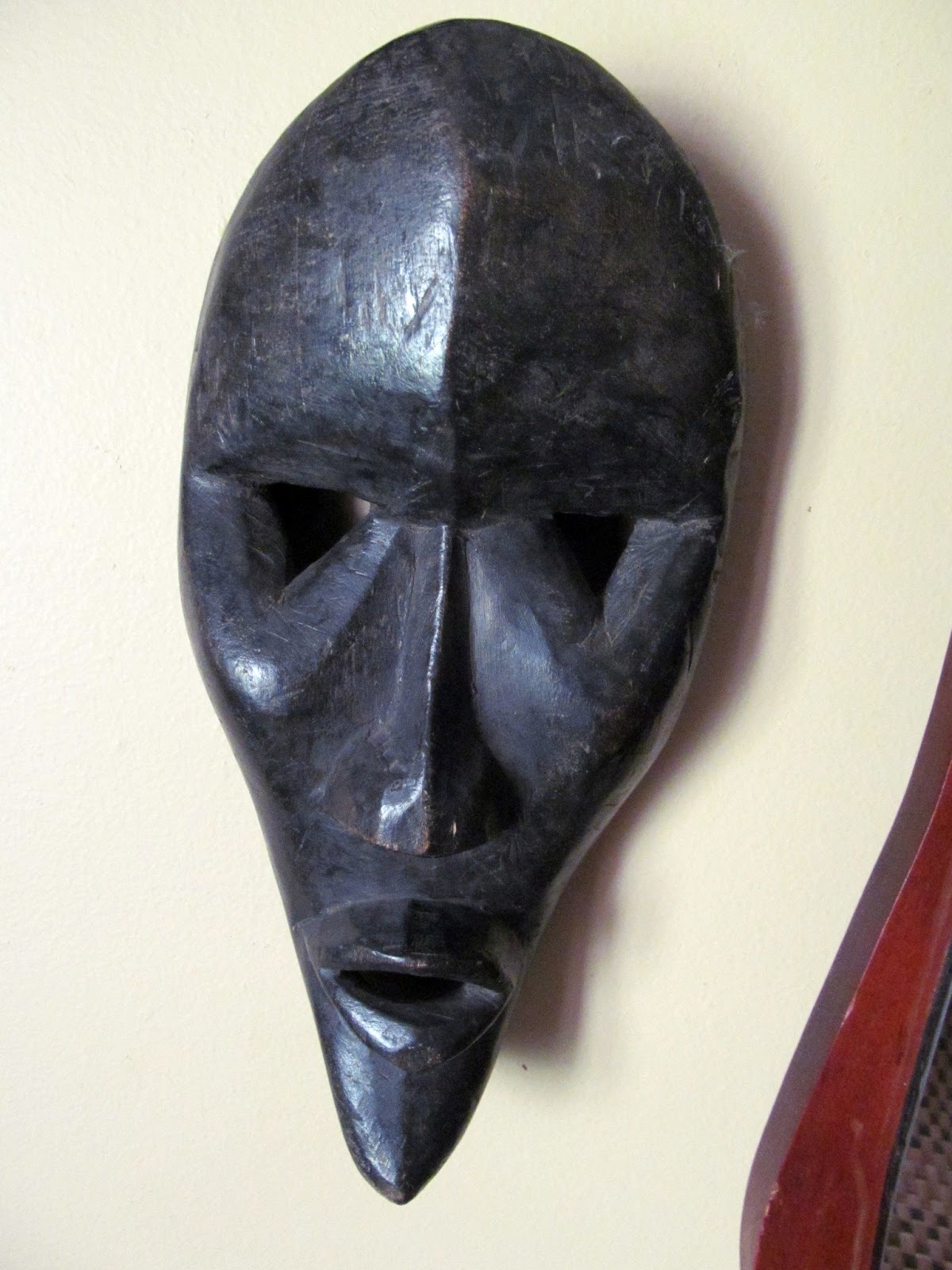
A Gio mask representing the
"Great Spirit of the Jungle"

It hints at the features of the gorilla 
and the crocodile 
And so it is with West African society that many of the societal roles are fulfilled by individuals wearing particular masks.  There are masks worn for judging between disputing parties; masks for retrieving debts; masks for performing sacred ritual;  masks for celebrating special days.  What gives these masks authority is not that the wearer has earned a degree from a respected university and passed some standardized test, but rather that the mask itself has the power to perform this particular task.  In this way the wearer of the mask does not take blame for doing what is done while wearing the mask, but rather the mask is simply doing his job and what needs to be done.  The same sort of mental gymnastics are performed by the masked executioners of our own Western tradition or uniformed soldiers who simply obey orders whatever the spirit of that order may be.  The uniform somehow convinces the wearer that they can do things they otherwise would never do.  The mask functions much the same way.


Plaque showing the 16 major tribes of Liberia
and the masks associated with each tribe.

Speaking of soldiers, in Liberia's recent civil wars there was much press given to the strange "costumes" worn by the combatants in the various rebel factions.  Notice was given to warriors wearing wedding dresses, wigs, toilet seats, Halloween masks, ad nauseam.  The idea was that by wearing these objects the wearer was imbued with certain powers that were found in that object.  (I'm not sure I want to know what power lives in the toilet seat!)  While this object wearing tends more towards what is called "fetishism" there is an overlap here with the concept of the mask. The mask is similar to this idea but it is also much more than that.  The mask is actually a living being that must be fed and prayed to as a living being.  Children have been taught at a very young age to pray to their mask every morning and seek its council.  When they prove themselves competent to handle a true mask, after passing through Poro or Sande initiations for example, either a new one was made for them or an ancestral mask was handed down to them.  The "feeding" of these masks involves sacrifice and the smearing of the blood and/or fat of the sacrifice on the mask.  Depending on the task to be done by the mask or the power and significance of the mask that sacrifice could either be animal or human.


Liberian mask.  Probably associated with the Snake Society
(Notice the snakes for hair and the snake coming from the mouth.)
Snake Society members are known for carrying around
a vial of venom that they lick daily to build up their immunity
They are known as master snake handlers and some are said to be able
to transform themself into a snake.
Samuel B. Wrisley Collection

Close up of the Snake Society mask's mouth  (see above).

Close up on "Snake Hair" on the Snake Society Mask (see above)

Seashells are woven into the back cloth of the Snake Society mask (see above)


Back of Snake Society Mask
A cloth has been nailed to the back
which covers the back of wearer's head
There was a very scholarly work done by Dr. George Way Harley on the masks of West Africa and particularly Liberia.  The name of this work is "Masks As Agents of Social Control in Northeast Liberia."  Dr. Harley was a Christian missionary in Ganta, Liberia and even met Graham Greene on his famous trek through Liberia that resulted in his ground breaking book "Journey Without Maps" to which this blog pays homage.  If you are interested in learning more about the function of these masks I highly recommend his paper on the subject.  Much of his collection of masks was given to the Peabody Museum at Harvard University and can be seen there or online at the provided link. 


A souvenir Liberian mask
Samuel B. Wrisley Collection

If you travel to Liberia, more than likely the only contact you'll have with Liberian masks are from the "charlies" (traveling salesmen), wood carvers (these are souvenirs and not true "living" masks) or the occasional masked street performer.  True masked "devils" are not to be seen by outsiders and the ones that dance in public are more touristy than anything.  However, one major faux pas is to try to touch or see behind the costume of the dancer even if he is just doing it for tips.  This traces back to the fact that true masked "devils" could punish the unauthorized person that saw him with death.  This is also why most masked dancers will be seen with a partner that keeps the raffia dress brushed down so no skin is showing and will also prevent any other inadvertent exposure on the part of the dancer.  


A masked "devil" performing.
Spectators believe the devil will bring them good fortune.


There are numerous types of masks and Dr. Harley's work does a great job in explaining many of them.  To sum, there are masks for every society and sub-society imaginable.  There are small masks for children and/or to be used as "passports" between tribes.  There are masks for the women and even one that supposedly makes the woman that wears it a man and able to go into the men's sacred grove.  There are masks for administrating sassywood ordeals or other such vicious ordeals to settle disputes.  There are death masks made especially to cover the face of a deceased yet important person.  There are masks worn by the circumciser on the day of ritual, the zoe while performer special ceremonies, the chief when handling certain situations, the town jester when things just need to be lightened up a bit.  The list could go on and on.  To sum, the mask is a concept that is much different to a Liberian than it is to an American and you would be better prepped to understand this culture by investigating those differences for yourself.