The following preparations are for a US Citizen traveling to Liberia, however much of it will apply to everyone who is getting ready to travel to Liberia. This is for a trip scheduled for June of 2013 and may be dated at the time of your reading so you may want to verify with more authoritative and current sources concerning any possible changes. However, as a general overview for your trip to Liberia here are the things you'll need to get in order...
Step 1: US Passport
If your passport is set to expire in the next 6 months you'll need to get a new passport. Your total cost for obtaining a US Passport should be roughly $80 - $200 depending on whether you are renewing are getting one for the first time. I broke down these costs below:
- The Passport Renewal fee is $60. (More information is found on the US State Department's "Passport by Mail" webpage).
- If it is your first passport the fee is roughly $150. (It has been awhile since I got mine but I found some Passport Fees on the US DOS site).
- Passport photos are approximately $20. (I got mine at Walgreen's photo center for about $17 if I remember right).
- I believe you will also need to send in your birth certificate and Social Security card (or a copy of it I can't remember) along with the required form to get your passport, but again it has been awhile since I did this. If you don't already have those documents you'll need to get those first.
- You will also incur some postage fees when you send in your documents which I wouldn't think should be over $15 - $20.
Step 2: Tickets/Ins.
Along with your ticket I recommend getting traveler's insurance. You usually get your travel insurance at the same time you purchase your tickets. The insurance would cover things like flying your body back in case of death and/or getting you to the nearest hospital (not too many options in Liberia for this so you would possibly be taken to another ECOWAS nation or to Europe) for your sickness or injury. It would also cover your medical care while there.
 |
Me and my mom heading to Liberia in 2011
in cramped Delta seats |
One used to be able to take a direct flight from Atlanta, Georgia to Accra, Ghana and then connect to Monrovia with Delta Airlines. That service has been discontinued although Delta still leaves from DC. I didn't like the lack of leg room on Delta and so perhaps a better way to get to Liberia is to connect with Brussels Air in Belgium. I suppose this would be sponsored by the Belgium diamond market - who knows? Anyway the trip from St. Louis, MO to Monrovia would take me about 20 hours in the air with 7 - 12 hours of layover for connecting flights. A typical round trip to Liberia from the US will take a solid 2 days of travel when you add both there and back. If you intend to go anywhere deeper inside Liberia than around Monrovia it would not be unusual to hear of it taking someone 3 days to get from their departure city to their arrival city in Liberia due to the conditions of many of the roads in Liberia.
 |
| A rainy day at Robertsfield International Airport in Liberia |
Your ticket to Liberia will cost you approximately $2000 - $2300 in fees, broke down as follows:
- Round Trip ticket (economy class app. $2000)
- Travel Insurance (roughly 5 - 6% of ticket cost)
- Luggage fees (depending on airline but $50 for one extra bag might be worth it if you're taking a lot of supplies for whatever aide work you might be doing)
Step 3: Accommodations
You will want to arrange your accommodations in Liberia before heading over there. The range in price depends on whether you are a guest of someone or if you are spending several hundred dollars per night at beautiful looking places like Kendeja Resort & Villas or the Libassa Ecolodge. I've been to neither place but they both look nice and expensive. (There is also a Hotel Listing for the Monrovia area online from the Liberia 101 site.)
 |
I stayed one night at Club Piso in Robertsport in 2011.
Unfortunately there were still mice (or rats as Liberians call them),
however I'm not sure if there are many places in Liberia without them. |
If you are staying as a guest at a guest house or in someone's home it would be proper to provide money for fuel for the generator to charge your electronics (see below) and possibly work something out for food money if they are also fixing food for you. The range for accommodations in Liberia is a wide margin between $200 - $2000 for a week depending on where you are staying and what your needs are. Also, remember to bring mosquito nets wherever you're staying! Which brings us to...
Step 4: Medical Prep
 |
| My "Yellow Book". Required to enter Liberia. |
Your total cost for vaccinations and medications for Liberia is going to cost anywhere from $350 - $800 depending on your consultation fees and types of medications you and your health consultant choose to purchase. However, after getting some of these vaccines you won't need to get them every time you go over to Liberia but rather every 5 - 10 years or in some cases never again. My cost for going over this time around would only be about $8 + my physician's consultation fee.
 |
Yellow Fever Vaccine Sticker
in my "Yellow Book" |
Yellow Fever Vaccine. This is required to enter Liberia and you will receive an appropriately colored Yellow Vaccine Book which records this and your other vaccinations. The cost for this vaccine depends on how you get it. If you go through a world travel organization you will have to also pay a consultation fee of anywhere between $25 - $75. Once you've met with your consultant though all further vaccines are included under that consultation fee. The cost of the actual vaccine is roughly $80 - $150 and is good for 10 years.
Hep A & B. I highly recommend getting these vaccinations as well. Most health workers already have them and their company paid for it, but if you aren't vaccinated you really need to be. This is a bit more complex as there are several different ways to administer the vaccine. I got TwinRex which included both A & B in the same vaccine. There is also a schedule of vaccinations to follow here as you'll get one vaccine on one day and have to wait a period before your next and then get your last one some 6 months later. I got my last one after returning from Liberia so I do know you don't have to run through the whole gauntlet of Hepatitis vaccinations before arriving in Liberia. You'll need to consult with a health professional for how this actually works but as far as costs go it was roughly $25 - $40 a dose for each type of Hepatitis. The whole regimen is roughly $140 - $300.
Typhoid - This comes in shot or oral dosage form and is also highly recommended for a visit to Liberia as there have been reported breakouts of typhoid there. Because I'm a chicken I got the oral dose, but actually the oral dose is better in my opinion also because it lasts longer (5 years) while the shot only lasts for 2. The price is roughly $75 for this vaccine.
A Malarial Prophylaxis - This is just a fancy way of saying "a medicine that helps to prevent you from getting malaria." The CDC has a great chart on the various different kinds of drugs you can take to help prevent malaria on their "Choosing a Drug to Prevent Malaria" webpage. When we lived there in the 70's and 80's we used to take Chloroquine, however now the malaria in Liberia has become chloroquine resistant. On our more recent trips we have had people taking both Malarone & Doxycycline with mostly positive results. Lariam has too many side effects in my opinion & I've not heard much about Primaquine. All of these meds have side effects and this is one of those things where you have to choose whether the side effects of the medicine are worse than the side effects of contracting malaria. I've had malaria several times and survived, but it can cause permanent organ damage and even death. I take a prophylaxis on shorter trips. For those staying long term you have to weigh the risks of long term use of the prophylaxis against the risks of getting malaria. Malarone was at one time $9/pill and it is taken once a day and continued for one week after getting out of the "malaria zone". Doxycycline is much cheaper and is also taken daily. Cost can range from $0.25 - $9/day for a malarial prophylaxis.
 |
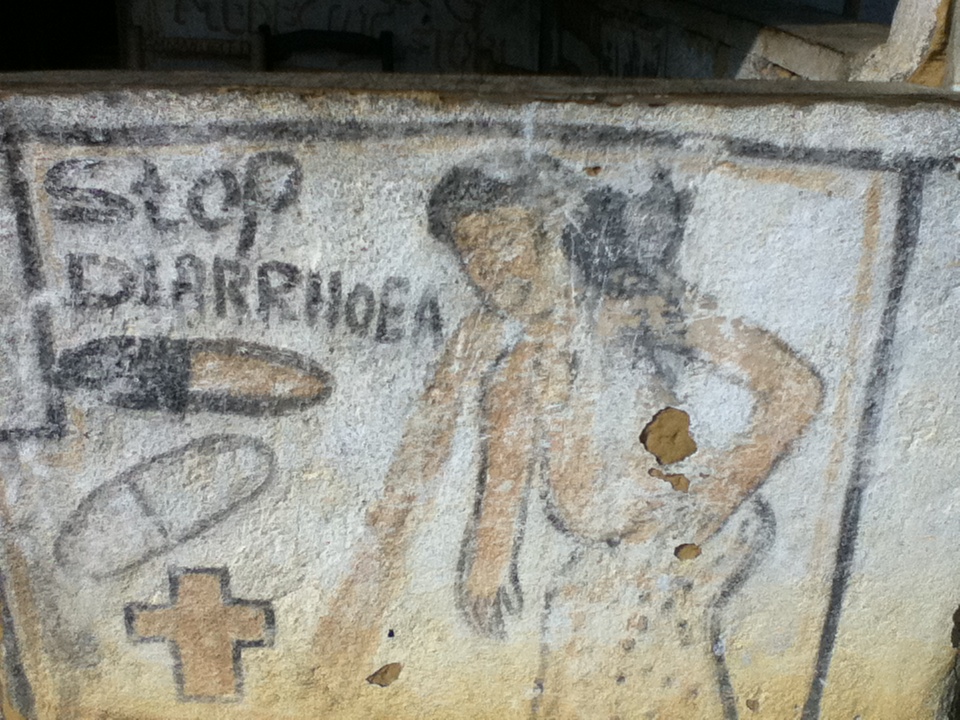
| A mural in Zondobli, Grand Bassa. Diarrhea can be fatal if not treated. |
Diarrhea treatment - We have typically taken Cipro (ciprofloxacin) in order to treat diarrhea if we get it while in Liberia. Cipro is relatively inexpensive and is one of the $4 Walmart prescription drugs. You'll have to tell either your doctor or your world travel consultant (see Yellow Fever above) in order to get the prescription, but after that fee the cost is not prohibitive. You might also want to bring an electrolyte supplement and/or an over the counter diarrhea medication to re-hydrate and stop the dehydration process respectively.
 |
| In need! |
Other Meds - You will also need to make sure you are up to date on your tetanus shot and definitely make sure and bring any meds with you that you would normally take in the States. You will also want to take some extra aspirin, ibuprofen, sunburn medicine, allergy meds & a small first aid kit. You might also want to bring some supplements like vitamins or probiotics or whatever else gets you going like Via instant coffee packs :-) Also, I've heard that taking Vitamin B-1 will help to reduce the amount of mosquito bites you'll get. I took it last time I went over and think it might of sort of worked somewhat perhaps? I also used eucalyptus soap to keep them away. All in all it seemed I had relatively few bites especially for rainy season.
Step 5: Liberian Visa
You'll need a visa to enter Liberia. There are many different types of visas. I'm discussing here the 1 - 3 month stay visa which is typical of a short term visit by a US Citizen. There is quite a bit of prerequisite tasks to complete and paperwork to organize in order to get your visa. For example, you need to have already gotten your passport (see above), yellow fever shot (see above), & flight itinerary (see above) before sending off for your visa.
 |
You'll need more passport size photos
for your Liberian visa |
You'll also want to have the names and contact info for a couple of people already living in Liberia in order to properly fill out your visa application. My total cost for getting a Liberian visa was about $160. Here are some of the other things you will also need and some of the fees required for obtaining a Liberian visa as a US Citizen:
- You will need to send along a copy of your yellow fever shot record (again see above)
- You will need 2 passport photos (app $20)
- You will also need to send along your passport. (Yes, you must send your actual, physical passport to the Embassy of Liberia in order to get your Visa. I've never had problems getting my back and neither has anyone on any of our teams that have gone over to Liberia for the past 7 years.)
- You will also place a self-addressed prepaid USPS/FEDEX/UPS envelope with tracking number in the envelope for return of your passport. (I also got a tracking number on my envelope to the Embassy and the total for both envelopes with postage paid was around $12).
- Optional: Same Day Processing ($75) / Next Day ($50). (I didn't get either one, but rather mailed my information out about 5 weeks before departure. I have heard of people not getting their visa because they didn't get their paperwork into the Embassy in time even though they mailed it a couple weeks before departure, however it was around Christmas time and that probably contributed to the delay. We've always gotten our visa on time and have usually sent in our paperwork 5 - 6 weeks before departure).
- All fees are to be paid in US Dollars via money order, cashier cheque or bank draft payable to the Embassy of Liberia. (I purchased a Postal Money Order for $131.00 while at the Post Office and there was a $1.20 fee attached to that. You simply fill out the money order like you do a check and make it out to the Embassy of Liberia. Also put your name and address on it in case their is a need for a refund. Then you tear off the upper Customer Receipt section for your records).
Step 6: Living Expenses
You will want to gather together the necessary funds to cover your living expenses while in Liberia.
Food/Drink in Liberia
 |
| The large fruit on the left is called a "Soursop" |
I am very out of touch with the Liberian food market prices. I feel fairly confident saying though that it will be cheaper to eat there than here if you eat local food. $10/day should more than cover your expenses. However, if you go to a "kwi" place to eat be prepared to pay perhaps even more than you do in the States for the food. I would just be sure to sample some of the famous Liberian gravies or soups that they pour over rice; especially palm butter. I would also highly recommend red oil fried grouper or smoked boney. Actually the list could keep going... Liberian food is great!
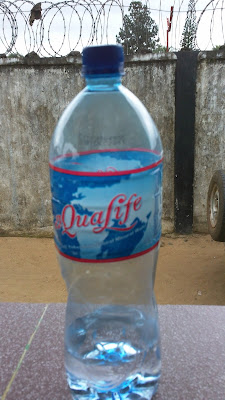 |
I drank Aqualife bottled water while in
Liberia to no ill effect |
The bottled water is usually safe to drink and I've had no ill effect from drinking these. The plastic bottle will be recycled multiple times in the market if given to the right people, but you may also want to bring a reusable water bottle and/or a water purifying bottle that has an actual water filter built into it.
Transportation/Taxi fares
 |
| A typical "Hold it - Hold it" or money bus taxi driving down Somalia Drive in Paynesville |
If you are going to be traveling a lot in Liberia this can really add up. Fuel is rather expensive but taxi fares are not that bad. If you will be reaching far I would budget $50/day and if you are staying put then perhaps a $5/day for going to market or wherever else you need to go nearby.
Electricity
 |
The nightly ritual of charging cellphones on a
surge protector plugged into a generator |
I have heard rumors of the "current" being back on in some areas of Monrovia. Even when I lived there in the 70's and 80's the current would "cut" very often and for extended periods. You will probably be relying on a small generator to charge up your cellphone, batteries, and other gadgets and will run it before going to bed to have a little night time light to unwind and set your rat traps. Fuel is rather expensive so depending on how many people can chip in on the generator it could cost you as much as $20/night depending on how long you need electricity to charge your items. I've never done so, but you could also pay to have someone else charge your stuff at a "charging station" (a generator powered booth that charges cellphones for people at a price). Personally I feel like too many things could go wrong with this scenario so I've never tried it.
 |
"Christ Still Cares Charging Spot" in Buchanan, Liberia
for all your cellphone needs. |
Step 7: Personal Items
You will want to purchase some personal items to make your stay in Liberia more enjoyable. There is no limit to the amount of money that one could potentially spend on equipment and nick knacks for taking to Liberia. However, if you are like me there is a definite limit whenever I check my bank account! Here are some practical items that you might consider purchasing for your trip to Liberia:
Clothes
 |
| You'll want to cover your head and ears from the sun from time to time |
Clothes should be quick drying and light weight. There is a strong chance they will also be hand washed and scrubbed on washboards and wrung out and hung in the sun. So they should still be a bit sturdy and something you will not be too upset in getting torn or stained. There are all sorts of things to consider and new items being marketed all the time for travel clothing. For example, Exofficio makes a brand of underwear that a dude supposedly traveled the world in by just washing and hanging up in his hotel bathroom at night. There are also Permethrin soaked clothing that supposedly stay mosquito resistant for up to 70 washing loads. ScotteVest makes a nice travel vest that you can store extra stuff in for carry-on and for Liberian walkabout. You might also need a sunhat, bandanna, neck gaiter, sunglasses or whatever else to keep the sun off of you especially if you are the least bit sensitive to the sun. It is 6 degrees from the equator in Liberia and has some strong sun-o!
 |
These Obama "Slippers" I saw in Liberia surely have
a great politician flip flop joke in 'em somewhere |
Shoes - got to get some flip-flops ("Slippa" as they're called in Liberia) and depending on how long you're there at least 2 pair. Boots could be useful if you plan on going into the bush but light cross trainers would work fine otherwise. If doing business some more formal shoes are OK and acceptable but most people will not be wearing these. Most of the chiefs and mayors and businessmen/women I met were all wearing sandals or flip flops, although a few wore comfy business shoes. I'd include some "wicking" or fast drying socks for your shoes as well.
Backpack/Luggage - You'll need to conform to your airline's regulations on size and weight when bringing your luggage. You should consider this before purchasing new luggage. Also, the luggage will most likely see some wear and tear so make it rugged. You might want to invest in a travel vest, back pack, money belt, and a duffle bag (to fold up and pack on the way in and fill up on the way out if the logistics work in your favor to do so).
 |
| If you travel much around Liberia your luggage will get some wear and tear |
Hygiene - I would pack a small portable mirror, your normal stuff in travel sizes, talcum powder, and some Boudreaux's Butt Paste (for chaffing). You'll also need some mosquito repellent I've got an earlier post written on what self hygiene might look like for you in Liberia here.
 |
| The beauty of Liberia awaits! |
Camera - There are many brands and set ups for camera and/or video. Whatever you do don't forget to bring one! The beauty of Liberia is breathtaking. I hope there are some brand spanking new Liberia pics to post here soon!
To Sum:
Your total trip costs for a 2 week trip to Liberia will set you back anywhere between $3000 - $5500 depending on what you need to purchase beforehand and what you purchase in Liberia. Hope you've found this information beneficial. Blessings to you all and God bless Liberia!
 |
| And the tree waves good-bye for now... |


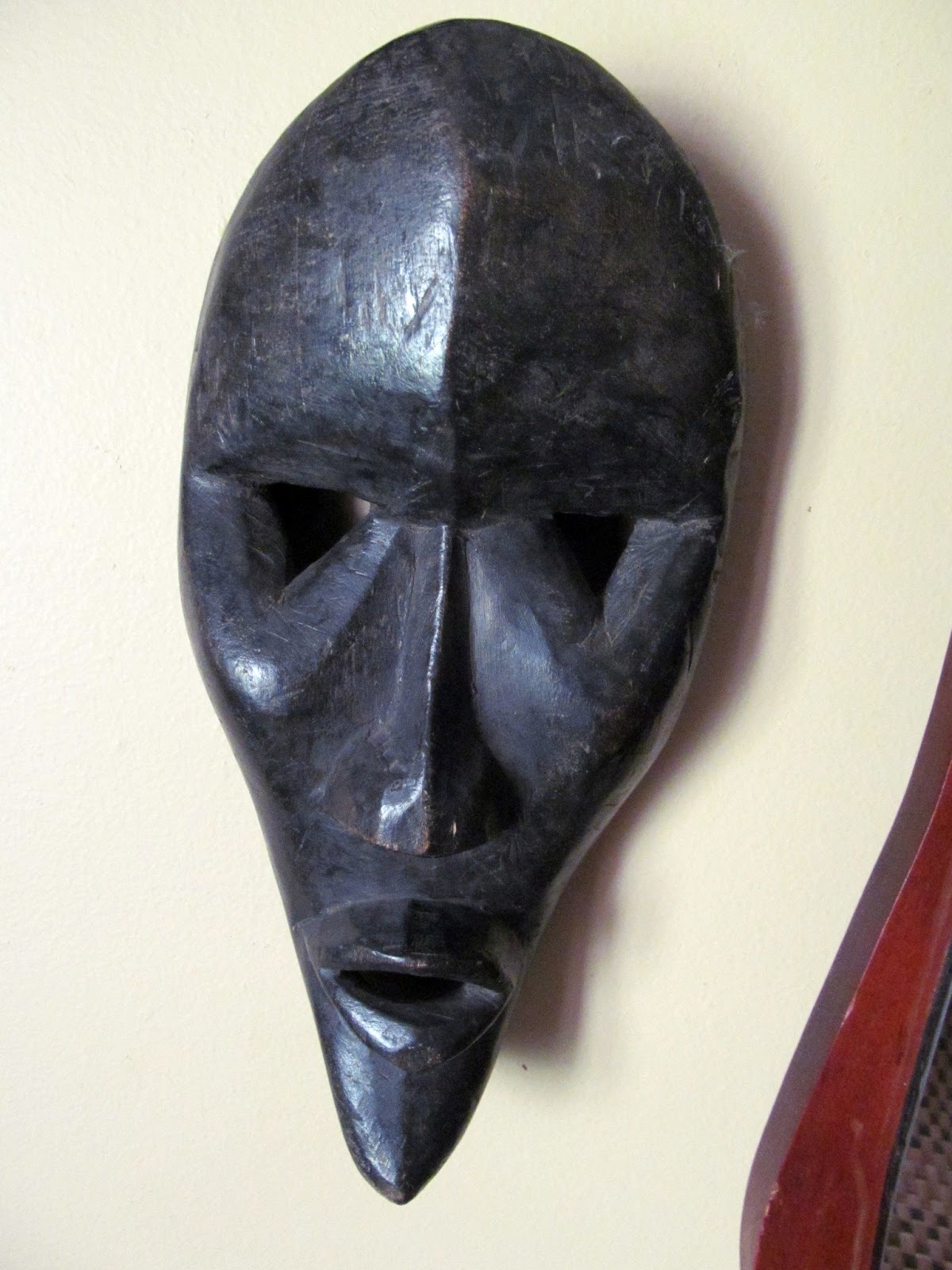

 There are numerous types of masks and Dr. Harley's work does a great job in explaining many of them. To sum, there are masks for every society and sub-society imaginable. There are small masks for children and/or to be used as "passports" between tribes. There are masks for the women and even one that supposedly makes the woman that wears it a man and able to go into the men's sacred grove. There are masks for administrating sassywood ordeals or other such vicious ordeals to settle disputes. There are death masks made especially to cover the face of a deceased yet important person. There are masks worn by the circumciser on the day of ritual, the zoe while performer special ceremonies, the chief when handling certain situations, the town jester when things just need to be lightened up a bit. The list could go on and on. To sum, the mask is a concept that is much different to a Liberian than it is to an American and you would be better prepped to understand this culture by investigating those differences for yourself.