Showing posts with label Liberia. Show all posts

Wednesday, April 17, 2013

How to Prepare for a Trip to Liberia

The following preparations are for a US Citizen traveling to Liberia, however much of it will apply to everyone who is getting ready to travel to Liberia.  This is for a trip scheduled for June of 2013 and may be dated at the time of your reading so you may want to verify with more authoritative and current sources concerning any possible changes.  However, as a general overview for your trip to Liberia here are the things you'll need to get in order...

Step 1:  US Passport


If your passport is set to expire in the next 6 months you'll need to get a new passport.  Your total cost for obtaining a US Passport should be roughly $80 - $200 depending on whether you are renewing are getting one for the first time.  I broke down these costs below:


  • The Passport Renewal fee is $60.  (More information is found on the US State Department's "Passport by Mail" webpage).  
  • If it is your first passport the fee is roughly $150.  (It has been awhile since I got mine but I found some Passport Fees on the US DOS site).
  • Passport photos are approximately $20.  (I got mine at Walgreen's photo center for about $17 if I remember right).
  • I believe you will also need to send in your birth certificate and Social Security card (or a copy of it I can't remember) along with the required form to get your passport, but again it has been awhile since I did this.  If you don't already have those documents you'll need to get those first.
  • You will also incur some postage fees when you send in your documents which I wouldn't think should be over $15 - $20.

Step 2:  Tickets/Ins.


Along with your ticket I recommend getting traveler's insurance.  You usually get your travel insurance at the same time you purchase your tickets.  The insurance would cover things like flying your body back in case of death and/or getting you to the nearest hospital (not too many options in Liberia for this so you would possibly be taken to another ECOWAS nation or to Europe) for your sickness or injury.  It would also cover your medical care while there.


Me and my mom heading to Liberia in 2011
in cramped Delta seats
One used to be able to take a direct flight from Atlanta, Georgia to Accra, Ghana and then connect to Monrovia with Delta Airlines.  That service has been discontinued although Delta still leaves from DC.  I didn't like the lack of leg room on Delta and so perhaps a better way to get to Liberia is to connect with Brussels Air in Belgium.  I suppose this would be sponsored by the Belgium diamond market - who knows?  Anyway the trip from St. Louis, MO to Monrovia would take me about 20 hours in the air with 7 - 12 hours of layover for connecting flights.  A typical round trip to Liberia from the US will take a solid 2 days of travel when you add both there and back.  If you intend to go anywhere deeper inside Liberia than around Monrovia it would not be unusual to hear of it taking someone 3 days to get from their departure city to their arrival city in Liberia due to the conditions of many of the roads in Liberia.


A rainy day at Robertsfield International Airport in Liberia

Your ticket to Liberia will cost you approximately $2000 - $2300 in fees, broke down as follows:


  • Round Trip ticket (economy class app. $2000)
  • Travel Insurance (roughly 5 - 6% of ticket cost)
  • Luggage fees (depending on airline but $50 for one extra bag might be worth it if you're taking a lot of supplies for whatever aide work you might be doing)


Step 3: Accommodations 

You will want to arrange your accommodations in Liberia before heading over there.  The range in price depends on whether you are a guest of someone or if you are spending several hundred dollars per night at beautiful looking places like Kendeja Resort & Villas or the Libassa Ecolodge.  I've been to neither place but they both look nice and expensive.  (There is also a Hotel Listing for the Monrovia area online from the Liberia 101 site.)


I stayed one night at Club Piso in Robertsport in 2011.
Unfortunately there were still mice (or rats as Liberians call them),
however I'm not sure if there are many places in Liberia without them.
If you are staying as a guest at a guest house or in someone's home it would be proper to provide money for fuel for the generator to charge your electronics (see below) and possibly work something out for food money if they are also fixing food for you.  The range for accommodations in Liberia is a wide margin between $200 - $2000 for a week depending on where you are staying and what your needs are.  Also, remember to bring mosquito nets wherever you're staying!  Which brings us to...


Step 4:  Medical Prep 


My "Yellow Book".  Required to enter Liberia.

Your total cost for vaccinations and medications for Liberia is going to cost anywhere from $350 - $800 depending on your consultation fees and types of medications you and your health consultant choose to purchase.  However, after getting some of these vaccines you won't need to get them every time you go over to Liberia but rather every 5 - 10 years or in some cases never again.  My cost for going over this time around would only be about $8 + my physician's consultation fee.  


Yellow Fever Vaccine Sticker
in my "Yellow Book"
Yellow Fever Vaccine.  This is required to enter Liberia and you will receive an appropriately colored Yellow Vaccine Book which records this and your other vaccinations.  The cost for this vaccine depends on how you get it.  If you go through a world travel organization you will have to also pay a consultation fee of anywhere between $25 - $75.  Once you've met with your consultant though all further vaccines are included under that consultation fee.  The cost of the actual vaccine is roughly $80 - $150 and is good for 10 years.  

Hep A & B.  I highly recommend getting these vaccinations as well.  Most health workers already have them and their company paid for it, but if you aren't vaccinated you really need to be.  This is a bit more complex as there are several different ways to administer the vaccine.  I got TwinRex which included both A & B in the same vaccine.  There is also a schedule of vaccinations to follow here as you'll get one vaccine on one day and have to wait a period before your next and then get your last one some 6 months later.  I got my last one after returning from Liberia so I do know you don't have to run through the whole gauntlet of Hepatitis vaccinations before arriving in Liberia.  You'll need to consult with a health professional for how this actually works but as far as costs go it was roughly $25 - $40 a dose for each type of Hepatitis.  The whole regimen is roughly $140 - $300. 

Typhoid - This comes in shot or oral dosage form and is also highly recommended for a visit to Liberia as there have been reported breakouts of typhoid there.  Because I'm a chicken I got the oral dose, but actually the oral dose is better in my opinion also because it lasts longer (5 years) while the shot only lasts for 2.  The price is roughly $75 for this vaccine.  

A Malarial Prophylaxis - This is just a fancy way of saying "a medicine that helps to prevent you from getting malaria."  The CDC has a great chart on the various different kinds of drugs you can take to help prevent malaria on their "Choosing a Drug to Prevent Malaria" webpage.  When we lived there in the 70's and 80's we used to take Chloroquine, however now the malaria in Liberia has become chloroquine resistant.  On our more recent trips we have had people taking both Malarone & Doxycycline with mostly positive results.  Lariam has too many side effects in my opinion & I've not heard much about Primaquine.  All of these meds have side effects and this is one of those things where you have to choose whether the side effects of the medicine are worse than the side effects of contracting malaria.  I've had malaria several times and survived, but it can cause permanent organ damage and even death.  I take a prophylaxis on shorter trips.  For those staying long term you have to weigh the risks of long term use of the prophylaxis against the risks of getting malaria.  Malarone was at one time $9/pill and it is taken once a day and continued for one week after getting out of the "malaria zone".  Doxycycline is much cheaper and is also taken daily.  Cost can range from $0.25 - $9/day for a malarial prophylaxis.  
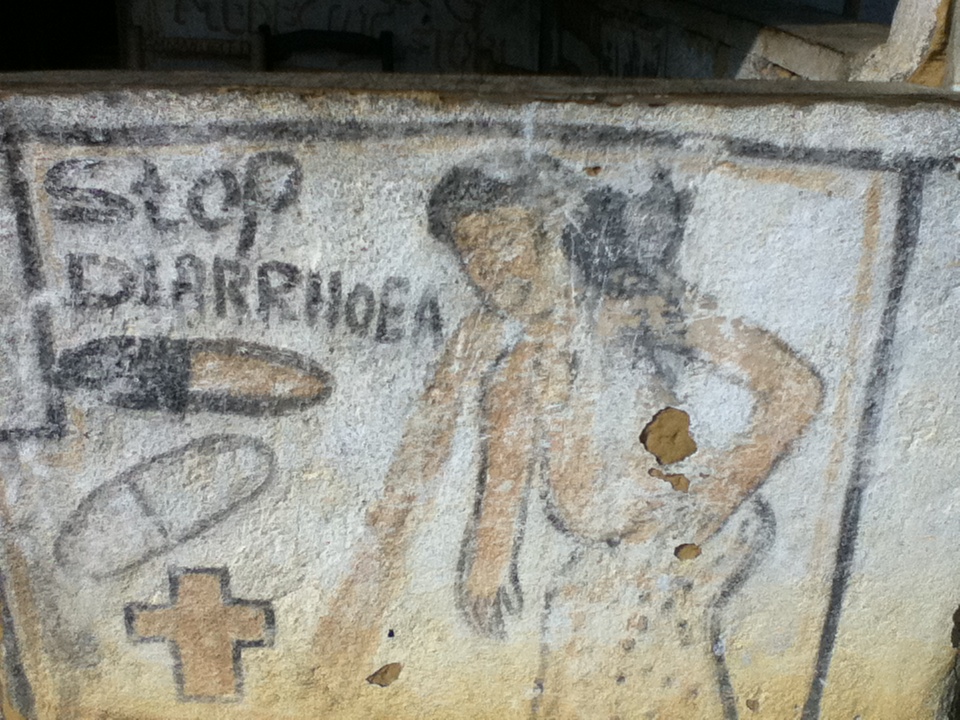

A mural in Zondobli, Grand Bassa.  Diarrhea can be fatal if not treated.

Diarrhea treatment - We have typically taken Cipro (ciprofloxacin) in order to treat diarrhea if we get it while in Liberia.  Cipro is relatively inexpensive and is one of the $4 Walmart prescription drugs.  You'll have to tell either your doctor or your world travel consultant (see Yellow Fever above) in order to get the prescription, but after that fee the cost is not prohibitive.  You might also want to bring an electrolyte supplement and/or an over the counter diarrhea medication to re-hydrate and stop the dehydration process respectively.  


In need!

Other Meds - You will also need to make sure you are up to date on your tetanus shot and definitely make sure and bring any meds with you that you would normally take in the States.  You will also want to take some extra aspirin, ibuprofen, sunburn medicine, allergy meds & a small first aid kit.  You might also want to bring some supplements like vitamins or probiotics or whatever else gets you going like Via instant coffee packs :-)  Also, I've heard that taking Vitamin B-1 will help to reduce the amount of mosquito bites you'll get. I took it last time I went over and think it might of sort of worked somewhat perhaps?  I also used eucalyptus soap to keep them away.  All in all it seemed I had relatively few bites especially for rainy season.

Step 5: Liberian Visa


You'll need a visa to enter Liberia.  There are many different types of visas.  I'm discussing here the 1 - 3 month stay visa which is typical of a short term visit by a US Citizen.  There is quite a bit of prerequisite tasks to complete and paperwork to organize in order to get your visa.  For example, you need to have already gotten your passport (see above), yellow fever shot (see above), & flight itinerary (see above) before sending off for your visa.  


You'll need more passport size photos
for your Liberian visa
You'll also want to have the names and contact info for a couple of people already living in Liberia in order to properly fill out your visa application.  My total cost for getting a Liberian visa was about $160.  Here are some of the other things you will also need and some of the fees required for obtaining a Liberian visa as a US Citizen:


  • You will need to send along a copy of your yellow fever shot record (again see above)
  • You will need 2 passport photos (app $20)
  • You will also need to send along your passport.  (Yes, you must send your actual, physical passport to the Embassy of Liberia in order to get your Visa.  I've never had problems getting my back and neither has anyone on any of our teams that have gone over to Liberia for the past 7 years.)
  • You will also place a self-addressed prepaid USPS/FEDEX/UPS envelope with tracking number in the envelope for return of your passport.  (I also got a tracking number on my envelope to the Embassy and the total for both envelopes with postage paid was around $12).
  • Optional:  Same Day Processing ($75) / Next Day ($50).  (I didn't get either one, but rather mailed my information out about 5 weeks before departure.  I have heard of people not getting their visa because they didn't get their paperwork into the Embassy in time even though they mailed it a couple weeks before departure, however it was around Christmas time and that probably contributed to the delay.  We've always gotten our visa on time and have usually sent in our paperwork 5 - 6 weeks before departure).
  • All fees are to be paid in US Dollars via money order, cashier cheque or bank draft payable to the Embassy of Liberia.  (I purchased a Postal Money Order for $131.00 while at the Post Office and there was a $1.20 fee attached to that.  You simply fill out the money order like you do a check and make it out to the Embassy of Liberia.  Also put your name and address on it in case their is a need for a refund. Then you tear off the upper Customer Receipt section for your records).


Step 6: Living Expenses


You will want to gather together the necessary funds to cover your living expenses while in Liberia.  


Food/Drink in Liberia
The large fruit on the left is called a "Soursop"

I am very out of touch with the Liberian food market prices.  I feel fairly confident saying though that it will be cheaper to eat there than here if you eat local food.  $10/day should more than cover your expenses.  However, if you go to a "kwi" place to eat be prepared to pay perhaps even more than you do in the States for the food.  I would just be sure to sample some of the famous Liberian gravies or soups that they pour over rice; especially palm butter.  I would also highly recommend red oil fried grouper or smoked boney.  Actually the list could keep going... Liberian food is great!


I drank Aqualife bottled water while in
Liberia to no ill effect
The bottled water is usually safe to drink and I've had no ill effect from drinking these.  The plastic bottle will be recycled multiple times in the market if given to the right people, but you may also want to bring a reusable water bottle and/or a water purifying bottle that has an actual water filter built into it.  


Transportation/Taxi fares
A typical "Hold it - Hold it" or money bus taxi driving down Somalia Drive in Paynesville

If you are going to be traveling a lot in Liberia this can really add up.  Fuel is rather expensive but taxi fares are not that bad.  If you will be reaching far I would budget $50/day and if you are staying put then perhaps a $5/day for going to market or wherever else you need to go nearby.


Electricity


The nightly ritual of charging cellphones on a
surge protector plugged into a generator
I have heard rumors of the "current" being back on in some areas of Monrovia.  Even when I lived there in the 70's and 80's the current would "cut" very often and for extended periods.  You will probably be relying on a small generator to charge up your cellphone, batteries, and other gadgets and will run it before going to bed to have a little night time light to unwind and set your rat traps. Fuel is rather expensive so depending on how many people can chip in on the generator it could cost you as much as $20/night depending on how long you need electricity to charge your items.  I've never done so, but you could also pay to have someone else charge your stuff at a "charging station" (a generator powered booth that charges cellphones for people at a price).  Personally I feel like too many things could go wrong with this scenario so I've never tried it.
"Christ Still Cares Charging Spot" in Buchanan, Liberia
for all your cellphone needs.

Step 7:  Personal Items

You will want to purchase some personal items to make your stay in Liberia more enjoyable.  There is no limit to the amount of money that one could potentially spend on equipment and nick knacks for taking to Liberia.  However, if you are like me there is a definite limit whenever I check my bank account!  Here are some practical items that you might consider purchasing for your trip to Liberia:


Clothes 
You'll want to cover your head and ears from the sun from time to time

Clothes should be quick drying and light weight.  There is a strong chance they will also be hand washed and scrubbed on washboards and wrung out and hung in the sun.  So they should still be a bit sturdy and something you will not be too upset in getting torn or stained.  There are all sorts of things to consider and new items being marketed all the time for travel clothing.  For example, Exofficio makes a brand of underwear that a dude supposedly traveled the world in by just washing and hanging up in his hotel bathroom at night.  There are also Permethrin soaked clothing that supposedly stay mosquito resistant for up to 70 washing loads.  ScotteVest makes a nice travel vest that you can store extra stuff in for carry-on and for Liberian walkabout. You might also need a sunhat, bandanna, neck gaiter, sunglasses or whatever else to keep the sun off of you especially if you are the least bit sensitive to the sun.  It is 6 degrees from the equator in Liberia and has some strong sun-o!


These Obama "Slippers" I saw in Liberia surely have
a great politician flip flop joke in 'em somewhere
Shoes - got to get some flip-flops ("Slippa" as they're called in Liberia) and depending on how long you're there at least 2 pair.  Boots could be useful if you plan on going into the bush but light cross trainers would work fine otherwise.  If doing business some more formal shoes are OK and acceptable but most people will not be wearing these.  Most of the chiefs and mayors and businessmen/women I met were all wearing sandals or flip flops, although a few wore comfy business shoes.  I'd include some "wicking" or fast drying socks for your shoes as well.

Backpack/Luggage - You'll need to conform to your airline's regulations on size and weight when bringing your luggage.  You should consider this before purchasing new luggage.  Also, the luggage will most likely see some wear and tear so make it rugged.  You might want to invest in a travel vest, back pack, money belt, and a duffle bag (to fold up and pack on the way in and fill up on the way out if the logistics work in your favor to do so).  


If you travel much around Liberia your luggage will get some wear and tear

Hygiene - I would pack a small portable mirror, your normal stuff in travel sizes, talcum powder, and some Boudreaux's Butt Paste (for chaffing).  You'll also need some mosquito repellent   I've got an earlier post written on what self hygiene might look like for you in Liberia here


The beauty of Liberia awaits!
Camera - There are many brands and set ups for camera and/or video.  Whatever you do don't forget to bring one!  The beauty of Liberia is breathtaking.  I hope there are some brand spanking new Liberia pics to post here soon!


To Sum:  
Your total trip costs for a 2 week trip to Liberia will set you back anywhere between $3000 - $5500 depending on what you need to purchase beforehand and what you purchase in Liberia.  Hope you've found this information beneficial.  Blessings to you all and God bless Liberia!

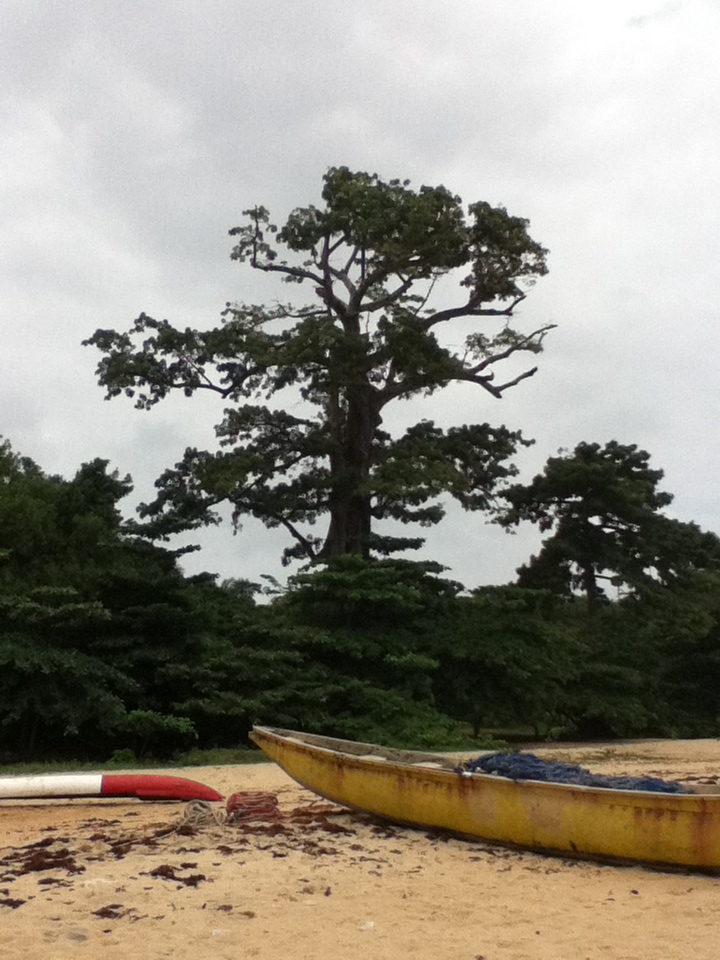
And the tree waves good-bye for now...


Friday, February 8, 2013

Graduation - Liberian Style

Graduate on parade in Buchanan c. 1977
Graduation Day and/or Senior Day in Liberia is much like a holiday.  Graduates get gifts, there are parades; people dress up in costume and paint; there is singing and dancing and partying and feasting.  These Liberian traditions of celebrating Graduation Day seem to tie into some of the Poro and Sande graduation ceremonies while also incorporating some Western influences from the "Settlers" as well.  They are so enmeshed I'm not sure I can separate out the two influences anymore than one could separate the influences upon Mardi Gras in the US Gulf South.  In fact, while participating in Liberian graduation ceremonies in 2011 I was reminded of the Krewes and parades of the Louisiana Carnival season of which I had observed with curiosity first hand while living there.  Surely the African culture played a significant role in the development of US Mardi Gras along with the Native Americans and the Europeans.  But back to Liberia...

Liberian revelers decked out for Graduation/Gala Day in Buchanan, Liberia c. 1977

Graduation or Gala "Queen" on her float
in parade through streets of Buchanan c. 1977
When I lived in Liberia in the 70's and 80's there was a different way that Liberian's celebrated Graduation Day and that seems to have changed.  In those days the graduates would parade through town dressed in a "military-style" costume.  This militaristic posing no longer dominates the graduation and gala day ceremonies in Liberia.  This is an understandable change.  You see, the demonic tsunami of death and destruction that ravaged Liberia throughout the 90's and up till 2003 was also dressed up in military garb and lingo.  Warlords called themselves 'general' so and so and dressed the part while also costuming out their posses of death with military uniforms as they were able.  The soldier became something to dread and fear and run from and lost any appeal it may have previously held in the mind of Liberians.  In other words, soldiers are not as "in vogue" in Liberia as they used to be.

                         Graduates in "military-themed" uniforms march in Buchanan c. 1977

Graduation Band marches through Buchanan with the crowd "second lining" the ceremony sans umbrellas c. 1977

What remains of these ceremonies are the colorfully painted family groups that march through town and disrupt traffic and oftentimes the actual ceremonies themselves.  In the States we urge the audience to refrain from clapping until everyone has received his or her diploma.  An occasional air horn and/or drunk dad sounds out even in our ceremonies and we typically shake our heads and smirk while waiting for "our" graduate to cross the platform so we can perhaps let out a little yelp of our own.  Our traditions do not allow anything that would completely overrun the ceremony itself.  This is not necessarily true in Liberia anymore and something that has also changed in her culture.  


Family and friends parade to the ceremony with singing and dancing


Undergraduates awaiting the beginning of the ceremony

Graduates ready to enter the building for the ceremony
Of the two graduation ceremonies I attended in Buchanan there was shouting and mobs of people running up to the front to carry off their graduate all through out.  The speech of the Dux (Valedictorian) and the names of other graduates were often not even heard announced amongst the noise.  This is not how graduation ceremonies were before the Civil Wars but it has become more the norm.  I would feel comfortable describing these new sort of "ceremony" as organized chaos hanging by a thread.  Throngs of people swarmed up and down the aisles and crowded the stage and even shouted down a school leader for not adequately paying the teachers or holding back their child's diploma.  It was rather intense to say the least!  


Graduates embrace family and friends outside after the ceremony

Outside the ceremony itself are even more family members and revelers waiting for their graduate to emerge.  They are often painted in school colors and decorated with palm branches.  They also like to hit metal cans or jugs or drums and chant and dance around the graduate.  There is a definite festive mood in the air!  Our vehicle was stopped en route to one ceremony by a group of partiers that actually started yelling and banging on our vehicle.  However, the smiles and laughter on their faces communicated that this was a celebration and not a riotous mob.  It was right on the line between sheer terror and joy for me, much like many things are to the foreigner visiting Liberia.


Graduation/Gala Day parade in Buchanan c. 1977
Liberia Christian High School

All in all the day or days of Graduation are marked with festivities and merriment.  Graduates are given gifts and lauded by relatives.  People are proud of their graduates and the graduates are all smiles at the attention.  The obstacles they have overcome in getting their education is indeed something to celebrate and the lessons they have learned in the process are more than "book".  May Liberia continue her proud tradition of celebrating those that seek education and may those that receive it give back to the communities that gave them the opportunity.  Blessings on Liberia!


The Queen rides through Buchanan c. 1977


Loading up in a truck for Graduation Parade, Buchanan, Liberia c. 1977

Dressed up and ready to party - Buchanan c. 1977

Smiles and shouting!

The Queen makes her way through Buchanan, Liberia c. 1977

You know its a party when the band starts!  Buchanan, Liberia c. 1977


Tuesday, November 20, 2012

Introduction to Liberian English - Part 2

Liberian Girl with a red deer (or duiker?) that is called by Liberians something that sounds like "Folding Tonga".  They are prized for their meat.

Due to the popularity of the earlier article on Liberian English I've listed some more terms and phrases that you can add to your travel dictionary.


This is Part II of an "Introduction to Liberian English"  You can visit that article in order to read a bit more about Liberian English itself and also see more Liberian English words and phrases defined.
________________________________

Baboon - this is actually what we call a chimpanzee and not what we would call a baboon.  I have no idea when, where, or how the change up came about, but when you hear a Liberian talking about a "baboon" think "chimpanzee".  

Book - can mean "the law" or simply used as a metonym for being educated.
  "That man know book"

Burst (possibly "bust"? pronounced "bus") - can mean to devour something; and also to injure something.  -- "damage" is also used for devouring food as in 'we damaged the palm butter'.
   "I tell you, I can bus some rice"

Bush - the interior or the tropical rain forest of Liberia; jungle.

Caustic - poison
  "She give them children caustic and they die-o"

Chaklah - to destroy or mess something up.  Not really sure where this comes from but I've heard it used the following way...   
    "The soldier come and chalklah the whole area"

Coal Tar ("koh tah") -  paved road versus the prevalent dirt roads that make up most of Liberia's road system.
   "The koh tah fini at the junction."

Congo - This is a term used to describe Americo-Liberians and not usually used of someone actually from the Congo.  The infamous Liberian chant "Country woman born soldier, Congo woman born rouge" which was sung when Doe overthrew the Americo-Liberian rule of Liberia in 1980 is an example of this term.  This chant/song infers that the "country" or indigenous peoples of Liberia (see below) gave birth to a conquering soldier (Samuel Doe) and all that the Americo-Liberians gave birth to were "rouges" or thieves that stole from Liberia.  

Country - this used to refer to any native Liberian who was not from the Americo-Liberian elite.  It now refers to the interior "bush" culture or area of Liberia and it is sometimes used as a derogatory comment in reference to someone or something being inferior.  This is true even if the people calling someone "country" are not Americo-Liberian themselves.  One example of this term is "country cloth" - the old hand made lappas that were made in the "bush" before the mass produced and printed lappas took over the Liberian markets of today.  Another example:  "She country" - I've seen this used both derisively and also with a smile while shaking the head which seemed to mean "that is just the way she is and I love her for it".

Cruso - Cashew.  I have no idea where this pronunciation comes from, but this is how it sounds to me when someone points to a cashew and says its name in Liberian English.  The actual cashew is thrown on the ground and is considered "caustic".  The cashew fruit is the part that is eaten and they are delicious!


My brother holding a "Cashew Apple"  -  the brown part on the top is the actual cashew nut

Cutlass ("culeh") -  machete.  According to a theory by Tim Butcher in his book on Liberia, "Chasing the Devil", this is a term left over from the age of Liberian coastal peoples interacting with European traders who called their swords "cutlasses" just like the old swashbuckling pirates of olden days.  
   "I have no culeh to make farm."

Devil - a costumed individual that dances in the streets with an entourage.  In the city this is sometimes for visitors, tourists or celebrations.  In the bush it is much more closely aligned with the Poro and Sande Secret Societies.  Devil Bush is another use of this term and is one of the names for the secret location in the jungle where initiations take place.  

Dialect ("dielay") - the indigenous languages of Liberia like Bassa, Kpelle, Vai, etc.  For example, at some churches that are for whatever reason in transition from their traditional language into English they might have both an English speaking choir and a "Dialect Choir" which sings in their first language.
  "Dielay choir director can sing-o!"

GB - You may see this advertised on street side chop shops.  It is a kind of hard and fermented fufu that is mostly preferred in Nimba County.  One swallows the hard blocks of GB and washes them down with a soup called "slippery soup" that sometimes contains rancid meat.  An acquired taste that some Liberians do not even like.  I have never tried it yet, and it isn't really on my bucket list either, but who knows?

Issue (or more specifically "Issue in the press") - This can refer to dog meat.  The story behind this is that most Liberians did not confess to eating dog before the Civil War when it was not considered civilized, but during recent hard times all food was game.  In order to keep one's dignity and not order "dog meat" to eat at the chop shop a system was created.  Dog meat was kept in a 5 gallon bucket and covered with newspaper and someone could order an "issue" of this paper and get dog meat.  A seller with fresh dog meat could then walk around with his bucket yelling "Issue! Issue in the press!" and thereby keep his dignity by not having to yell, "Dog meat!  Get your fresh dog meat here!"  Some developed a taste for dog after having to eat it during those days and an "issue in the press" can still be found in the market if you are so inclined to look for it.  There are many in Liberia who love dog meat today however I am not planning on trying this!

Juke - to stab, often used to describe a painful injury or to intimidate
   Example of intimidation:  "You know me?  I will juke you!"

Monkey Apple - there are actually two completely different fruits that are both called "monkey apple" in Liberia.  One is the fruit that we would call a "star fruit" the other I have never seen in the US and have pictured below.
This red spikey fruit is also called a "Monkey Apple".  The red skin is peeled off and a grape-like, slimy yet sweet substance surrounds the seed inside.

My People Coming (or "My people now coming") - this is a phrase used when someone believes they might die or when they are so terrified they feel that their life is in danger.  I watched a grown man leap over a patio wall while he was yelling, "The soldier here!  My people now coming - o!"  I was running right behind him!

Not Correct - someone who has to face more than the average amount of mental challenges.
  "That woman is not correct."

Plum - the is what we would call a mango.  There are different varieties with different seasons.  I remember one mango that Liberians called a "German plum" that I liked.  When you hear "plum" in Liberia think "mango".  

Reed  ("ree") - this is what we would call bamboo.  To make matters a bit more confusing there is actually another plant with very thin stems that Liberians do call bamboo.
  "We got plenty ree for cutting." - as in "We have an abundance of bamboo to make things with."

Sliding - this is the Liberian term for "surfing" as is captured in the surfing documentary "Sliding Liberia"

OK --- Well, there you have some more Liberian English terms and phrases that have come to mind today.  I hope to do another entry sometime later as I recall more.  I'm due for another trip back and I'll try to take better notes next time.  Remember the best way to get the proper pronunciation and rhythm is to go to Liberia and speak with and listen to the people of Liberia.  Blessings!

Saturday, June 2, 2012

Cotton From Trees?


Kapok Ceiba pentandra in KolkataWest BengalIndia.
Note: 'This closely resembles the cotton tree fruit in Liberia as well'
photo by J. M. Garg


The scientific name is ceiba pentandra (variety guineensis).  In Liberia it is called the 'cotton tree'.  As you can tell from the above picture of its fruit the name fits.  These cotton trees are easy to recognize even when they are not covered with their cotton-like fiber.  This is because they tower above the surrounding forest standing 'head and shoulders" above the rest.


The famous Cotton Tree of Robertsport


author playing in a cotton tree
The trees have a spreading plank buttress trunk that look like folded wood drapes in larger trees.  One could sneak between the folds of the spreading trunk and be completely hidden from view!  The trunk also often has prickly sections of thorns that I suppose detract enemies of the plant.  The trunk itself is an amazing work of organic sculpture that brought out the boy in me.  I had fun climbing around on its roots and trunk folds.


Some of the prickly thorns that can grow on the trunk of a cotton tree (ceiba pentandra)


Cotton tree in Zondobli, GBC, Liberia
Varieties of this tree grow in all sorts of tropical climates around the world.  Some scientist speculate that the tree actually originates in the Americas and a variety of this tree was sacred to the Mayans as a tree of life which was climbed upon death.  Some however speculate that it originates in Africa.  The variety in Liberia seems to me to be bigger than most, if not the biggest variety.  Of a related note is the fact that the tree seems to have held some sort of sacred meaning to some Liberians as well.  In reading about ancient customs of the Bassa tribe, for example, I found that sometimes the youngest son of the chief was buried with his father.  This cruel practice involved placing the live child in the ground with his deceased father holding a bowl that contained the seeds of the cotton tree.  The cotton tree that would later grow from this grave site would be a sort of memorial to the chief.  Perhaps it holds some of the same associations with death that the Mayans held?  Whatever the case, whenever I saw a cotton tree I always wondered if this was the old grave of a chief and some poor child was unwillingly planted with this tree.


Mom by a cotton tree near Doedehn, GBC, Liberia c. 1985


Folding trunk of the Cotton Tree of Robertsport
The trees can grow upwards of 200 ft. tall and can have a trunk of immense diameter as you can tell from these pics.  I have seen cotton trees even bigger than this one near the beach at Robertsport.  However, this particular tree has a legend with it in that J. J. Roberts (the first president of Liberia) arrived here in the late 1800's on a ship from the United States that tied itself to this tree.  Hence, the name of this town: Robertsport.  As a historical aside, Roberts was actually born in Norfolk, VA and today would've been considered a US citizen.  He was sent to Africa under the guidance of the American Colonization Society in their efforts to send "free people of color" back to Africa.  This whole ordeal is a part of US history often overlooked and ties our nation with the nation of Liberia in ways that need to be further explored.  In a way, this historical tree symbolizes this US - Liberia connection.  Whether it is the stuff of legends or not one cannot deny this beautiful giant is hundreds of years old and worthy of the preservation efforts that it has received in the past.


Looking up at a cotton tree
The cotton tree can offer more than just the pleasure of looking at it.  From what I've read people have tried to use the cotton-like fiber of these trees like regular cotton, although they have found it difficult to spin.  Therefore, it is mostly used as filler when harvested for commercial purposes and this is done today in parts of SE Asia where it is harvested.  The seeds found in the fiber are sometimes pressed for their oil which is found to be fairly resistant to drying out.  The wood of the tree itself is light and easy to carve and Liberians have used it for boats, mortars and carvings among other things.  I would hope though that not too many of these amazing trees are harvested in the rampant de-forestation that has plagued Liberia recently.  More about that later....


I'll end with a short video of the Cotton Tree of Robertsport so that you can better appreciate the size and beauty of this amazing tree.


Thursday, May 31, 2012

Remembering To Move Forward

They say that a picture is worth a thousand words.  But the words that pictures can speak are not just content, they are often heart, soul, connection and deep memories that have perhaps been filed away and forgotten.  Some things within us are just waiting to be re-awakened by an old picture.  I don't know how many times I've looked at an old photo and thought, "Wow!  I totally forgot about that!  What a great memory!"  This isn't a luxury available to most Liberians.


Those of you who have lost pictures in a fire or flood or some other disaster can relate to the pain of not having your wedding photos or high school yearbooks available anymore.  I've been told it feels like you've lost a connection with some part of yourself that can no longer be accessed without those visual aides.  You can probably relate to this aspect of Liberian suffering.  Liberians have lost most of their photographic record.


Not only did Liberians have their pictures destroyed in the war by having to flee and leave them exposed to bombings, fire, rain, and other forms of mayhem; some Liberians actually had to go through the painful process of destroying these memories with their own hands!  You see, to be identified with a certain tribe, organization, education level, etc. could mean that you would be put to death.  One friend of ours was killed after rebels stopped him and asked him to write his name on a wall.  When he demonstrated this ability they shot him.  It was better to destroy all evidence of affluence, connection and education than to make yourself a target.  Therefore, people burned these memories and with them part of Liberia's history was lost forever.


Several years ago I was contacted by a Liberian friend that I have known for over 35 years.  His name is Floyd Morgan.  As a child I used to play everyday with Floyd and his brothers Melvin and Garmondeh.  He is among the majority of Liberians that no longer have pictures of their past.  He had no clear recollection of what he and his brothers looked like as children.  That was about to change...


It was while going through an old shoebox of photos from Liberia I came across a picture that caused me to jump for joy.  It was a pic of the Morgan boys as small children.  I couldn't wait to email this to Floyd.  I did.  The picture caused quite a stir among their family!  They were overjoyed to have this piece of their family history restored.  They printed off the picture and made copies and showed it to relatives.  They were amazed at how they looked at that age.  They had all the same sort of experiences we have when we see an old pic of ourselves, except it was magnified many times over due to the tragic circumstances they've suffered since the picture was taken.


"Childhood Friends" L to R:  Melvin, Floyd, me, Garmondeh


I am happy to report the small miracle that all of the Morgan boys lived through the brutal Civil Wars in Liberia.  Their stories are heart wrenching and difficult to process.  The lingering trauma has to be heavy for them to carry.  This pic provided a small relief and caused them to remember that there was a time when things were better, or at least seemed to be better. They had access to those allusive "good old days".  


This picture brought some healing with it.  Perhaps this seems trivial to those of us who are inundated with image overload on a daily basis, but the power of these historical records is immeasurable and life changing. As Sando Moore, a Liberian photojournalist who lost all of his photo archives in the wars, said, "If you don't know where you come from.  How can you know where you are going?"  Indeed.  


This is why I was excited to come across Liberia77 while researching Liberia online.  This organization was founded by two Canadian boys that grew up in Liberia in the 70's (much like my brother and I had).  They also had a treasure trove of Liberian photos and when they showed President Sirleaf their favorite pic of Liberia she urged them to put out the call for more.  The president understood the significance of showing Liberia what Liberia once looked like before she was ravaged by war.  I sent their organisation some of our pictures.  One was even selected as an editor's pick!  It is a cause worth checking out and a site worth exploring.


Back to the Morgan boys.... Some 35 years after that first picture was taken I was back in Liberia and in contact with Floyd.  It was surreal to see him again and he promised to contact his brothers who were also living in Monrovia.  It was like stepping back into childhood when all three of the Morgan boys pulled up at the Paynesville home where we were staying.  They carried a printed version of our childhood pic in their hand.  I presented them with framed and blown up copies I had made at Kinko's before coming over.  One for each of them and one for their mother to remember how her children once looked.  We laughed and hugged and caught up a bit.  We also reenacted our poses from 35 years earlier.  What an amazing memory!  The power of that picture was working on us, empowering us, re-connecting us and perhaps even reaching out and speaking to you as well.


"35 Years Later" L to R:  Melvin, Floyd, me and Garmondeh (I had trouble getting into the same pose -- knees and hips aren't what they used to be!)