Showing posts with label ACS. Show all posts

Saturday, June 2, 2012

Cotton From Trees?


Kapok Ceiba pentandra in KolkataWest BengalIndia.
Note: 'This closely resembles the cotton tree fruit in Liberia as well'
photo by J. M. Garg


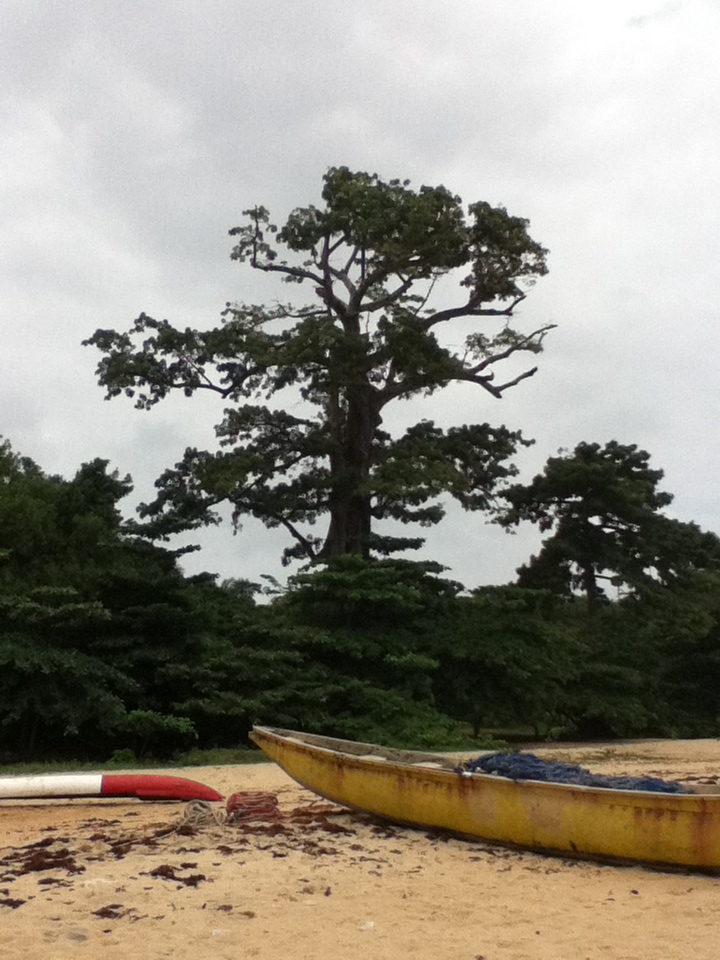
The scientific name is ceiba pentandra (variety guineensis).  In Liberia it is called the 'cotton tree'.  As you can tell from the above picture of its fruit the name fits.  These cotton trees are easy to recognize even when they are not covered with their cotton-like fiber.  This is because they tower above the surrounding forest standing 'head and shoulders" above the rest.


The famous Cotton Tree of Robertsport


author playing in a cotton tree
The trees have a spreading plank buttress trunk that look like folded wood drapes in larger trees.  One could sneak between the folds of the spreading trunk and be completely hidden from view!  The trunk also often has prickly sections of thorns that I suppose detract enemies of the plant.  The trunk itself is an amazing work of organic sculpture that brought out the boy in me.  I had fun climbing around on its roots and trunk folds.


Some of the prickly thorns that can grow on the trunk of a cotton tree (ceiba pentandra)


Cotton tree in Zondobli, GBC, Liberia
Varieties of this tree grow in all sorts of tropical climates around the world.  Some scientist speculate that the tree actually originates in the Americas and a variety of this tree was sacred to the Mayans as a tree of life which was climbed upon death.  Some however speculate that it originates in Africa.  The variety in Liberia seems to me to be bigger than most, if not the biggest variety.  Of a related note is the fact that the tree seems to have held some sort of sacred meaning to some Liberians as well.  In reading about ancient customs of the Bassa tribe, for example, I found that sometimes the youngest son of the chief was buried with his father.  This cruel practice involved placing the live child in the ground with his deceased father holding a bowl that contained the seeds of the cotton tree.  The cotton tree that would later grow from this grave site would be a sort of memorial to the chief.  Perhaps it holds some of the same associations with death that the Mayans held?  Whatever the case, whenever I saw a cotton tree I always wondered if this was the old grave of a chief and some poor child was unwillingly planted with this tree.


Mom by a cotton tree near Doedehn, GBC, Liberia c. 1985


Folding trunk of the Cotton Tree of Robertsport
The trees can grow upwards of 200 ft. tall and can have a trunk of immense diameter as you can tell from these pics.  I have seen cotton trees even bigger than this one near the beach at Robertsport.  However, this particular tree has a legend with it in that J. J. Roberts (the first president of Liberia) arrived here in the late 1800's on a ship from the United States that tied itself to this tree.  Hence, the name of this town: Robertsport.  As a historical aside, Roberts was actually born in Norfolk, VA and today would've been considered a US citizen.  He was sent to Africa under the guidance of the American Colonization Society in their efforts to send "free people of color" back to Africa.  This whole ordeal is a part of US history often overlooked and ties our nation with the nation of Liberia in ways that need to be further explored.  In a way, this historical tree symbolizes this US - Liberia connection.  Whether it is the stuff of legends or not one cannot deny this beautiful giant is hundreds of years old and worthy of the preservation efforts that it has received in the past.


Looking up at a cotton tree
The cotton tree can offer more than just the pleasure of looking at it.  From what I've read people have tried to use the cotton-like fiber of these trees like regular cotton, although they have found it difficult to spin.  Therefore, it is mostly used as filler when harvested for commercial purposes and this is done today in parts of SE Asia where it is harvested.  The seeds found in the fiber are sometimes pressed for their oil which is found to be fairly resistant to drying out.  The wood of the tree itself is light and easy to carve and Liberians have used it for boats, mortars and carvings among other things.  I would hope though that not too many of these amazing trees are harvested in the rampant de-forestation that has plagued Liberia recently.  More about that later....


I'll end with a short video of the Cotton Tree of Robertsport so that you can better appreciate the size and beauty of this amazing tree.


Monday, May 14, 2012

A Bit Of The US South In Africa

Americo-Liberian Home in Edina, Liberia
photo by Ken Vogel

Liberia is an African Republic with towns that have US sounding names like New Georgia, Virginia, Kentucky and Louisiana.  The reason goes back to our own US history when the US government funded an organization called the American Colonization Society (ACS) to purchase land in Africa to send "free people of color" back to Africa.  What was some of the reasoning behind this?

"Congo-style" house, Robertsport, Liberia
Ever since the Haitian slave revolt many slaveholders were terrified of the idea that their slaves might also revolt.  Seeing or hearing about these "free people of color" walking about might give slaves the motivation they needed to revolt.  So many Southern slaveholders joined the ACS and many had the intention of sending any slave they freed back to Africa instead of being allowed to walk about free and proud in the antebellum South.  There are also claims that some of these freed slaves were children born to master's through their slaves that they wanted to hide away from their community by sending them to Africa.  This was one line of thought in the ACS.

"Congo Home" Edina, Liberia
photo by Ken Vogel
The ACS was also joined by abolitionists who surely made strange bedfellows with the slaveholders.  Their reasoning was that it is not safe for a "free person of color" to stay in the US.  A freed person would have to carry around paperwork proving they were free and could be stopped at any time simple due to the color of their skin.  The opportunities available to a person of minority skin color were also very limited in the US and many who opposed slavery didn't just want people free they wanted them to be able to thrive in a viable society.  Many of these people foresaw the decades upon decades of integration issues that would surely follow after emancipation and wanted a better life for those who were freed.  They thought, "perhaps in going back to Africa they will have a better chance of living freely."  

Mt. Zion Baptist Church, Robertsport, Liberia
Many of the "Free People of Color" were fairly skeptical of the whole ordeal, but some saw the same opportunities that some of the abolitionists had seen.  In fact, it was a free person of color and devout Quaker "Paul Cuffee" that helped lay the groundwork for the ACS.  Many of these groups of freed slaves that returned to Liberia were also sponsored by churches to evangelize Africa.  The reasoning was that someone of the same skin color would be more effective in this missionary work, what had perhaps not been considered was that culture is not a matter of skin color.  These Americo-Liberians, as they are called, brought the South with them and converts were Americanized just as much or perhaps even more than Christianized.  One tragic part of the South that these freed slaves brought with them was that some of these Americo-Liberians enslaved the native Liberians to work on their plantations!   

Americo-Liberian Plantation, Edina, Liberia
photo by Ken Vogel
What I'm sharing with you today are some of these Americo-Liberian homes and/or plantations and churches that sprung up all along the coast of Liberia.  I find them quite beautiful even in their deteriorated states.  The native Liberians call the Americo-Liberians "Congo" and call these houses "Congo Houses" so that is why they are sometimes so captioned.  To someone from the US they definitely resemble old Southern architecture and it is rather surreal to see the US South standing in the middle of a tropical rain forest in Africa! 

Congo Home, Edina, Liberia - photo by Ken Vogel

Memorial to Americo-Liberian and Liberian president Joseph Cheeseman in front of
US Southern - style home, Edina, Liberia
photo by Ken Vogel
Congo Homes in Robertsport, Liberia
Congo Home in Robertsport, Liberia
Congo House on a Hill - Robertsport, Liberia

Congo home in Robertsport, Liberia
If you'd like to see some more pictures of these Liberian Congo-style homes you can check them out on this interesting site I found here.  

Monday, May 7, 2012

What’s Up With The Liberian Flag?


Flag of the Republic of Liberia


A US citizen will immediately recognize that the Liberian flag looks an awful lot like our flag.  Why?  The reason is that Liberia was an African colony founded by US born individuals.  There were actually many US backed colonies with US sounding names like Mississippi-In-Africa and the Republic of Maryland.  You see, what happened was that many in the US population at that time (early 1800’s) were unsure and/or uncomfortable with how to integrate the “free people of color” (what free African Americans were called at that time).   So some US citizens founded the ACS (American Colonization Society) with the intention of sending these free people of color ‘back to Africa’.  I don’t know of any US schools that teach this in history class for whatever reason, but they should I think!

Old Stars and Stripes
So the short answer to the question about the flag is that freed slaves, born in the US, founded colonies in Africa and once these colonies organized into the Republic of Liberia in 1847 they adopted a flag like the flag of their country of origin. 

Today this flag is better known (at least in the Maritime Industry) for another reason:  a flag of convenience. You will often see a Liberian flag flying over a ship because the regulations and taxes are much less than most other ports of registry.    In fact, the tiny country of Liberia at one time held the largest registry of ships in the world!   Even to this day, the small nations of Liberia, Panama and Marshall Islands account for 40% of the world’s entire fleet.  This US-inspired flag now brings in much of Liberia’s revenue and the reason for this use of the Liberian flag also had US origins.

The Amoco Cadiz was a Liberian flagged ship that ran aground in 16 March 1978
and created the largest oil spill in history up to that date.  This event led to laws
giving port states more authority in inspected ships in their port.

Early in WWII Liberia became a key place to transport troops.  Troops would avoid German U-boats by going south from the US to Brazil and east over to Liberia where they would set out to engage the enemy in Northern Africa and ultimately in Europe.  Liberia was also a major contributor of rubber for the war effort as the home of the world’s largest rubber plantation: Firestone.  During this time frame, the US Secretary of State, Edward Stettinius, who was also a friend of Liberian president William Tubman , came up with an idea to bring revenue into Liberia.  As an astute businessman (past president of Diamond Match Company) he helped create the ‘Liberia Company’ in 1947 which in turn brought funds to Liberia and US financiers by registering ships under the Liberian flag. 

So perhaps the next time you take a cruise or see a ship in port flying a flag that looks an awful lot like ours but with only one star --- you’ll know a little of the inside scoop.