Showing posts with label Bassa. Show all posts

Friday, February 1, 2013

How the Bassa Got Their Name


There are several histories out there concerning the Bassa people of Liberia.  Some claim they descend from the Abyssinian people and from this their name was derived (i.e. “A-bassa-nia”) others claim differently.  Dr. Syrulwah Soma has written a book on the history of the Bassa (Nyanyan Gohn Manan: History, Migration and Government of the Bassa) in which he proposes that there were actually Bassa on the throne of Egypt as Pharaohs and that at one point in their history the Bassa traded with Hano of Carthage and led armies in conquest of ancient India.  One thing is certain and that is that there is a common oral tradition among the Bassa as to how they got their name.    

Today I will share this theory with you on how they got their name “Bassa.” I received this first from Dr. Abba Karnga, a man who has done much to try and preserve the ancient tales, proverbs and customs of the Bassa people.  The following tale is a common oral tradition among the Bassa concerning how they came to be called “Bassa”.

Dr. Abba Karnga and Heath Vogel in Buchanan, Liberia in 2011

The areas of modern day Liberia in which the Bassa are concentrated (roughly Grand Bassa and parts of Margibi & River Cess Counties) was at one time called the “Gboo” territory.  They were named after Chief Gboo, who was an ancient and mighty chief of the people that would later be called Bassa.   These people who were ruled by Gboo were called “Gboo Nyohn Bey” which simply means “Gboo’s people.”  The name of this ancient tribe changed from Gboo Nyohn Bey to Bassa during the arrival of the Europeans.  Here is how that happened…

An Old Map of Liberia showing "BASSA COVE" near Pennsylvania Colony which was settled by Black Quakers from Pennsylvania during the ACS/Back to Africa Movement

When the Europeans arrived on the Liberian coast to trade in iron, pepper and slaves they met with the Gboo Nyohn Bey  on the coast (possibly around modern day Buchanan which was first called Basa Cove by the Europeans).  At that time the chief in that area was a man who called himself Mr. Rock (or Father Stone as some say).  Now the Bassa word for ‘rock or stone’ is ‘Saw’ and the Bassa word for ‘master or father’ is ‘Bah’ and so Chief “Bah Saw” became the man with whom the Europeans did their business.  Mr. Rock’s servants who interacted with the Europeans called themselves the “Bah Saw Nyohn Bey” or “Mr. Rock’s People”.  Chief BahSaw and the “Bah Saw Nyon Bey” therefore became a representative of the Gboo Nyohn Bey to the European traders.  As it was difficult for the Europeans to call them “Bah Saw Nyohn Bey” they shortened it to “Bah Saw” or simply “Basa” as some of the old European maps show.  And so that is how the name Bassa was placed upon Chief Gboo’s people.  

Monday, November 26, 2012

Get Some Bassa Rhythm!

Bassa Dialect Choir Drummers
The bigger drum keeps time and the smaller drum improvises

One of my "touristy" goat skin Liberian drums
Here is a basic Bassa rhythm that I was taught as a kid in Liberia.  It is from a Bassa song that has something to do with a man that had gold in his pockets, so a happy song!  I used a touristy goat skin drum I picked up along the street in Monrovia as I could not find the actual Bassa drums for sale.  Supposedly the traditional deer skins are hard to find as people chop bush meat into smaller pieces with disregard to the skin and the deer are becoming more difficult to find.  


Bassa drummer bringing the beats to a congregation heading down to the river for a baptism

This first video then is the basic beat that would be played on the bigger square drum and the second video is of the rhythm that is played on the smaller drum.  These rhythms are slowed way down and also in reality there would be two drummers each playing one of the drums at the same time, but hopefully this gives you the idea!


Of course if you'd rather not learn to play and just listen check out a couple of these Bassa Dialect Choir recordings I made in the summer of 2011.  The lighting is bad in the night one and the sound can be rough at times, but you can hear loud and clear those drums beating out some fine Bassa rhythm!  Enjoy-o!


This guy can rock out!....


I dream of someday drumming like these guys....


Saturday, November 24, 2012

The Day I Entered a Poro "Devil Bush"

I've written a little about the so-called "Devil Bush" in several articles here.  It is a kind of sacred grove hidden in the bush where secret societies like the Poro and Sande meet for their secret rituals.  It is a place where non-initiates are threatened with death if they trespass; a place I unknowingly entered into when I was 13.  Here is the story of how all of that went down ...

BACKSTORY

We arrived in Liberia in 1976 at the request of some Bassa leaders that were looking for teachers from the US for their school.  My dad then taught in Buchanan, the county seat of Grand Bassa County, and it was through this that he became connected with an individual that made another request of my dad:  he wanted him to come speak in his village.  This individual was a Liberian who had become a Christian and he wanted my dad, who is also a pastor, to come and speak in his village about Christianity.  My dad agreed and made the trek.

According to old newsletters that my parents had written around that time the name of this village was "Doowin".  (This was at least how it sounded to my dad when he heard the name.)  It was quite a hike back into the deep bush and upon arrival the entire village came out to meet the group that had journeyed together with my dad.  Everyone spoke in Bassa and dad was able to get pieces of information from the welcome ceremony from translators.  Entering this village must have been like entering another world for my dad.  Here's what he pieced together from that...

WELCOMING CEREMONY

The visitors to the village were joined together with the villagers in a big circle under the open air in the middle of the village.  The Chief of Doowin (sp?) walked into the circle and greeted the visitors in the presence of everyone there.  To the best of my dad's recollection, in his hands was a plate that had an egg on it and also a small pile of salt and a small pile of dirt.  These obviously symbolized something and dad remembers getting a brief explanation, but does not remember exactly what that explanation was.  It seems that it had something to do with being invited into the community.


Chief of Doowin presenting the visiting group with an egg,
dirt & salt in a bowl
 - photo by Ken Vogel

THE STRANGE WHITE MAN

Dad remembers how the village was curious about seeing a white man.  Everyone kept stealing glances at him to see if he was for true.  They listened with interest to his presentation of some basic Christian concepts through a Bassa translator.  They watched him as entered the guest hut.  They watched him again with fascination as he brushed his teeth.  They watched as he performed this strange ritual of spitting and rinsing into a cup and then "wasting" his spit water on a nearby rock.  He looked and behaved so very strange and must have been quite the talk of the town.

DOOWIN REVISITED

I was not old enough to make this initial hike with my dad.  However about 9 years later, when he was asked again to return, I got to go with him.  I remember sitting in a small, mud and stick church that first evening there after our long hike.  I remember that everything was spoken in Bassa except when my dad was asked to speak.  Then I recall that everyone got quiet as an old man got up to speak in Bassa.  Here is the basic translation of what he said....

THE DEVIL BUSH

He recounted how he remembered when my dad came to visit their village several years before.  He remembered how he had talked about this strange, new god who had power over death.  He then remembered that this white man had taken his spit and thrown it on their sacred rock in front of everyone.  (Apparently the rock dad had thrown his toothpaste water on was their village god!)  He remembers waiting to see what would happen to this man who had challenged their god in front of the entire village.  Surely their god would strike this man dead!  When the white man lived the village met and decided that this white man's god must have more power than their god and placed their faith in this new god.  After the white man had left and with a new found courage in this new god they went into the Devil Bush and cut it down and in its place they had built this church where we now worship this new god, Jesus.  In fact, the very place where I was sitting that evening had been the gathering spot for Poro.  In the community's new spirit of openness instead of secretiveness I had been invited to enter into their very own most sacred space.  I had entered into the Devil Bush and lived to tell about it!


The village of Doowin gathered around to welcome the new visitors (Aug 1977)
photo by Ken Vogel

Alright, so perhaps this wasn't what you were expecting?  Perhaps you were wanting me to share some kind of deep, dark secret that I had witnessed in a Neegee ceremony (a missionary actually did join the Neegee once by the way but that is another story) or some amazing tale about how I had barely survived attempts on my life for trespassing on Poro sacred ground.  In fact, depending on your personal views on Poro and Sande this whole tale is either a terrible tragedy to Liberian culture or it is an amazing testimony to the power of God to use people who have no idea what they are doing.  

I will end by saying that from my perspective it was far better to have been in the sacred grove at peace with my Liberian brothers and sisters than it would have been if I had been in that same grove 10 years earlier.  Had it happened then my life would have surely been threatened just for simply being there.  That they shared their sacred space with me instead of threatening me to stay away speaks of true love and hospitality.   From my point of view the fact that I was invited into fellowship with Liberians as they worshiped was far better than being excluded because I wasn't born in the "correct" culture.  

You may ask, "But didn't you just feel more comfortable with them because they now worshiped the white man's God?"  To which I would reply, "We are all children of God and last I checked Jesus was actually Middle Eastern, not white."  The teaching of the Bible is that the Blessing is available to all nations, races and ethnic groups through Abraham's Seed.  Anyone can know the peace that transforms us from excluding others from our sacred space to opening wide the doors to our fellow human beings (whether that exclusion be a Poro society or an all white, suburban church in the US).  Shalom.  

Sunday, June 10, 2012

The People Groups of Liberia

"The Sixteen Tribes"
A Popular Carving Piece Sold in Liberia
When the US encouraged and supported groups of "free people of color" to return to Africa in the 1800's they did not arrive at a desolate land.  These Americo-Liberians, as they became called, found a variety of ethnic groups already living and settled in what is now modern day Liberia.  Ethnologists and linguists have discovered all sorts of groups and subgroups, but the traditional number of Liberian tribes is 16.  These 16 people groups can themselves be structured into 3 linguistic groups:


  • Mel (consisting of the Gola and Kissi tribes)
  • Kru (Bassa, Bella, Dei, Grebo, Krahn, Kru)
  • Mande (Bandi, Gio, Kpelle, Loma, Mandingo, Mano, Mende, Vai)


NOTE: These groups are notorious for having a multitude of different spellings and names.  For example, the "Gio" are also called the "Dan" or the "Yakuba"; the "Loma" are also called the "Buzi"; and the "Mende" are also known as the "Boumpe", "Hulo", or "Kosso".  Besides the different names one may encounter for some of these people groups there are a multitude of different spellings for almost all of these groups.  For example the "Kissi" people can be listed as "Kisi", "Gisi", "Gizi", or "Kissien".


Traditional Territories of Liberian Tribes
Creative Commons License


Largest Ethnic Groups in Liberia

The four largest people groups in Liberia make up over 50% of the population.  The largest group is comprised of the Kpelle people (aka Gbese, Kpele, Kpesso, Kpwesi, Kpwessi, Pessa, Pessy) and they make up approximately 20% of the entire population of Liberia.  The second largest group is the Bassa who make up roughly 16%.  The Gio/Dan (8%) and the Kru (7%) round out the top four most populous tribes of Liberia.  


Who Were the First Liberians?


The Earliest Settlers

Who were the earliest settlers of Liberia? Was it a Gola/Kissi proto-tribe? The Dei? The Dua? Many histories I've read believe that it was the Gola people who were the first to arrive in what is modern day Liberia.  However, traditions have been passed on that when they arrived they found some Dei (De, Dei, Dewoi, Dewoin, Dey) peoples already settled here. Even more mysteriously these Gola found the Jinna (Jina) or more specifically the Dua (Dwarf) peoples. 


Jinna and Dua

The Jinna (associated with our word 'geni') are apparantly spirit beings with great magic and come in all sorts of shapes and sizes and bodies. One particular type of Jinna are the Dua people and it is speculated by some that they were the first Liberians.  These Dua have become the thing of legends (although some still claim to have seen them) and they were possibly a pygmy race that lived in caves and the hollows of fallen trees while living off the jungle in ancient Liberia.  They also possessed great magic power and so they have become associated with the Jinna or as a manifestation of the Jinna. The Jinna in general are believed to know deep magic and they still continue to play a role in Liberian legend, lore & ritual.  For a great definition and illustration of this read "WARNING! Do Not Bathe or Wash Clothes Today and Tomorrow, You Must Not Eat!"


The Kissi People

Another early group are the Kissi and they are perhaps associated with these early Gola. Perhaps there was a proto group from which they both derive? Whatever the case, the Kissi people are classified in the same linguistic family with the Gola. The problem with that is they are not mutually understood and in fact, some linguists have placed Gola in its own peculiar language grouping.  The Kissi are today found not too far from the Gola in Liberia (and also in Sierra Leone and Guinea) and I'll discuss two interesting features of the Kissi here.  First, they have been known to sharpen their incisors for cosmetic and/or ritualistic purposes.  Secondly, they are most famously known for their iron bars that they used as money (called Kissi pennies) up into the 20th century.


The Second Wave

The second major wave of peoples to arrive still remain on the edges of recorded history thousands of years before Christ.  This group was known as the "Kumbas" or the people of King Kumba.  This  chief Kumba apparantly conquered the Golas and set up his ancient empire in what is now Liberia.  After his death his peoples subdivided into what is now known as the Bandi, Kpelle, Loma, Mano, Gio, and Mende.  


The Third Wave


A Traditional Bassa Greeting
For more on this event check out "The Spotted Man of Zondo and His Ancient Horn"

In comparatively more modern times (1500's AD) a third big migration of Kru (sometimes called Kwa) peoples came from the modern-day Cote d'Ivoire area.  This group comprised of the Bassa, Bella, Dei, Grebo, Krahn, and Kru.  The Kru are interesting in that they settled the coast and were skilled sailors and fishermen and today are major players in the fishing industry of Liberia.  This also meant that they were the ones most targeted for forced ship labor by European ships.  Some speculate that their name "Kru" derives from the word "crew" into which they were often conscripted. The Kru were also targets of a modern day (1900's) conscription in the infamous Fernando Po incident that I'll discuss in a later post.


The Last 'Native' Migration to Liberia


The last great migration before the Americo-Liberians arrived in the 1800's comprised of the Vai (Gallinas, Gallines, Vei, Vy) and Mandingo (Mandinka, Malinke, Mandinko) peoples.  They came in waves during the 16th and 17th centuries respectively and are similar in two major aspects.  First, both of these groups are from the same linguistic family (Mande).  Secondly, they are both Muslim.  (Liberia is roughly 10% Muslim and these two groups make up the bulk of the population of this religious perspective in Liberia.  It is estimated that Liberia is also 30% Christian and 60% Animistic, although these stats seem to be in constant flux).  

There are some differences between these two Mande groups however. For example, the Vai are quite settled in Northwest Liberia and parts of neighboring Sierra Leone, the Mandingo people however continue to have much larger population centers outside of Liberia.  Liberia has approximately 200,000 Mandingo, but compare this to the nations of Guinea (3,000,000), Mali (2,600,000), Burkina Faso (2,000,000), Niger (1,900,000) and The Gambia (714,000 - where they make up 42% of the population).  In Liberia the Mandingo make up close to 7% of the population but they draw on these other larger population centers outside of Liberia to become a major force of trade and business dealings in Liberia.  In other words, they are small in population size in Liberia, but they are well-connected throughout West Africa.


Some Traditional "Devil" Costumes found on a wall in Vai Territory
Robertsport, Liberia
Other Ethnic Groups Living In Liberia

There are also other people groups that add to the diversity of the culture of Liberia.  One group is the Lebanese and Syrian business community that used to dominate the trade in Liberia.  Since the UN presence after the Civil Wars however this group has had major competition from Indian, Pakistani and Chinese businessmen.  The Fanti people from Ghana also continue to reside in Liberia and trade in the fishing industry.  Besides these major sub-groups engaged in Liberian culture there are also many businessmen from neighboring African nations (especially members of ECOWAS) and European and North American communities mostly focused on humanitarian causes.


A Fanti Town near Buchanan, Liberia

The Wonderful Mix That Makes Liberia

Take all of these people groups together with the Americo-Liberians from the US and you get a very interesting mix of cultures, languages (approximately 32 (counting dialects)) and ethnicities.  Liberia is a melting pot of cultures that sometimes clash and sometimes compliment one another.  There has also been a lot of intermarriages and several aggressive national unification initiatives that have brought about blurred lines between these tribal distinctions.  This is especially true in the city of Monrovia which now is home to almost 30% (1,000,000) of the population all by itself!  Outside of Monrovia and especially as one gets away from any of the Liberian cities and further into the traditional territories of specific tribes and clans these distinctions will become more defined and the old traditions will be more valued and preserved by the people living there.  As one can see, Liberia is a very diverse and complex experience!      


Saturday, June 2, 2012

Cotton From Trees?


Kapok Ceiba pentandra in KolkataWest BengalIndia.
Note: 'This closely resembles the cotton tree fruit in Liberia as well'
photo by J. M. Garg


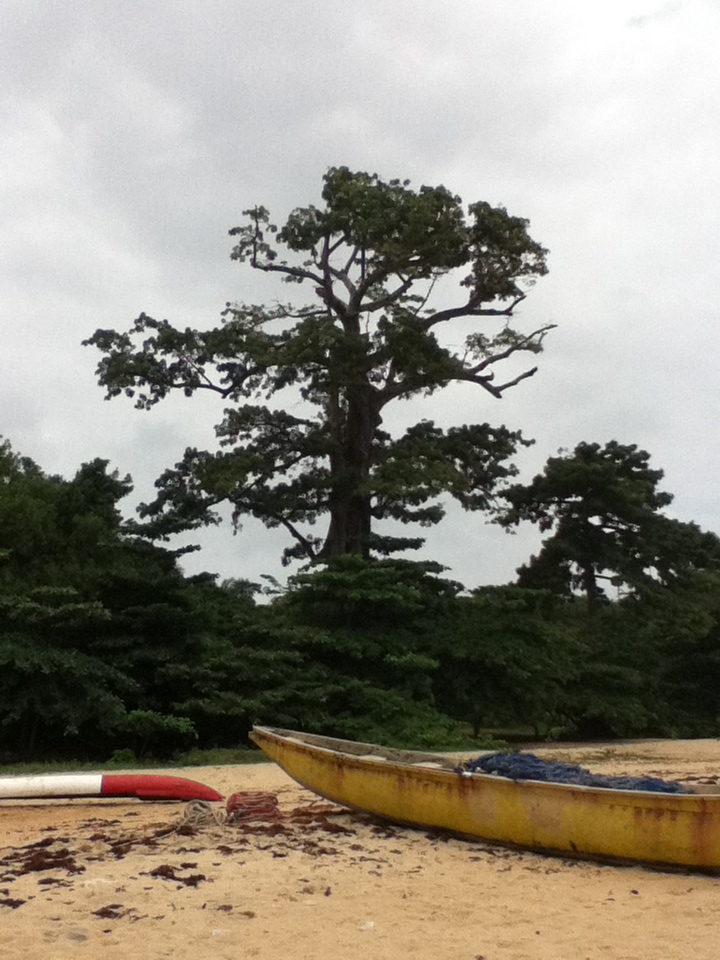
The scientific name is ceiba pentandra (variety guineensis).  In Liberia it is called the 'cotton tree'.  As you can tell from the above picture of its fruit the name fits.  These cotton trees are easy to recognize even when they are not covered with their cotton-like fiber.  This is because they tower above the surrounding forest standing 'head and shoulders" above the rest.


The famous Cotton Tree of Robertsport


author playing in a cotton tree
The trees have a spreading plank buttress trunk that look like folded wood drapes in larger trees.  One could sneak between the folds of the spreading trunk and be completely hidden from view!  The trunk also often has prickly sections of thorns that I suppose detract enemies of the plant.  The trunk itself is an amazing work of organic sculpture that brought out the boy in me.  I had fun climbing around on its roots and trunk folds.


Some of the prickly thorns that can grow on the trunk of a cotton tree (ceiba pentandra)


Cotton tree in Zondobli, GBC, Liberia
Varieties of this tree grow in all sorts of tropical climates around the world.  Some scientist speculate that the tree actually originates in the Americas and a variety of this tree was sacred to the Mayans as a tree of life which was climbed upon death.  Some however speculate that it originates in Africa.  The variety in Liberia seems to me to be bigger than most, if not the biggest variety.  Of a related note is the fact that the tree seems to have held some sort of sacred meaning to some Liberians as well.  In reading about ancient customs of the Bassa tribe, for example, I found that sometimes the youngest son of the chief was buried with his father.  This cruel practice involved placing the live child in the ground with his deceased father holding a bowl that contained the seeds of the cotton tree.  The cotton tree that would later grow from this grave site would be a sort of memorial to the chief.  Perhaps it holds some of the same associations with death that the Mayans held?  Whatever the case, whenever I saw a cotton tree I always wondered if this was the old grave of a chief and some poor child was unwillingly planted with this tree.


Mom by a cotton tree near Doedehn, GBC, Liberia c. 1985


Folding trunk of the Cotton Tree of Robertsport
The trees can grow upwards of 200 ft. tall and can have a trunk of immense diameter as you can tell from these pics.  I have seen cotton trees even bigger than this one near the beach at Robertsport.  However, this particular tree has a legend with it in that J. J. Roberts (the first president of Liberia) arrived here in the late 1800's on a ship from the United States that tied itself to this tree.  Hence, the name of this town: Robertsport.  As a historical aside, Roberts was actually born in Norfolk, VA and today would've been considered a US citizen.  He was sent to Africa under the guidance of the American Colonization Society in their efforts to send "free people of color" back to Africa.  This whole ordeal is a part of US history often overlooked and ties our nation with the nation of Liberia in ways that need to be further explored.  In a way, this historical tree symbolizes this US - Liberia connection.  Whether it is the stuff of legends or not one cannot deny this beautiful giant is hundreds of years old and worthy of the preservation efforts that it has received in the past.


Looking up at a cotton tree
The cotton tree can offer more than just the pleasure of looking at it.  From what I've read people have tried to use the cotton-like fiber of these trees like regular cotton, although they have found it difficult to spin.  Therefore, it is mostly used as filler when harvested for commercial purposes and this is done today in parts of SE Asia where it is harvested.  The seeds found in the fiber are sometimes pressed for their oil which is found to be fairly resistant to drying out.  The wood of the tree itself is light and easy to carve and Liberians have used it for boats, mortars and carvings among other things.  I would hope though that not too many of these amazing trees are harvested in the rampant de-forestation that has plagued Liberia recently.  More about that later....


I'll end with a short video of the Cotton Tree of Robertsport so that you can better appreciate the size and beauty of this amazing tree.


Friday, May 18, 2012

The Gods Of Ɓǎkèɓiɖ́í

Ɓǎ "Father" at the  Ɓǎ kè dà  site
photo by Ken Vogel
The children of the village screamed in terror when they saw me.  It had been about 20 years since a kùìpúú (kwee-poo - white person) had entered this village and that was the first time many had seen someone so light skinned.  I was told that some of the children thought we were spirits as white chalk is sometimes painted on people around those parts when they transition through "Bush School".  During this time they are considered invisible, or dead to the world, or somehow in a different spiritual realm.  The secret societies that oversee these schools have 'eaten' the child and once school is over they are considered adults and ready for marriage.  Until they are finished with this school they are painted white.  Therefore we appeared to some to be walking ghosts.  No wonder they were terrified!


I was 12 when we entered this village called Ɓǎkèɓiɖ́í (Bawe kaye blee) in the Moweh region of Grand Bassa County (now River Cess).  On the trek I saw and heard a "wudu" bird that had been known to swoop down and carry small children (from what I was told) and in the village I touched electric jungle catfish.  I plan on sharing more about some of the strange creatures I've either seen or heard about in this mostly unexplored part of the world.  However, today I want to share a particular memory about this village that I'll just call Bahkebli in case your browser doesn't support my Bassa font.


 "Mother" at the  Ɓǎ kè dà  site
photo by Ken Vogel
The day after we arrived we were taken a mile or so outside of the village to their old sacred spot called Ɓǎ kè dà (Bawe Kaye Dawe; Father and mother (in-law)).  It consisted of two gigantic boulders that rose above the surrounding jungle.  In days past these boulders were worshiped as "Father" and "Mother" of the village.  In between the two boulders were many smaller rocks that were called their 'children".  There was also a flat rock area where they offered sacrifices.  Usually food and animals, but they spoke of people being tied there as well.  They didn't go into details and I'm not sure if it was a sort of fertility ritual between the Zo (priest) and a maiden of the village and/or if it included actual human sacrifice.  Whatever the case, these rituals where how they 'fed' their gods and kept them happy.  


Imagine that you were taking these pictures for a moment and then turned directly behind yourself 180 degrees.  There you would see a mountain rising above the Liberian rainforest.  I was told that if the proper sacrifice was not made or if someone tried to dishonor these gods (or their Zo) that they would be taken to this mountain.  There were caverns in this mountain and the offender would be forced to enter the caverns and face the power of these gods within.  The guide told me that people would get lost in those caves and go crazy.  I'm not sure how they knew that as I also got the impression that anyone who entered those caves would never be seen again.  Perhaps someone escaped at one point and was found insane?  


In the forefront is the chief of Doedehn - Old Man Droh - who led us to Bakebli
photo by Ken Vogel
Whatever the case, these memories left quite an impression on a 12 year old boy and I hope to someday go back and document and more fully verify these tales.  I have so many questions I would like to ask.   I wonder if the town still exists after the Civil War?  I wonder how the people are doing?  I remember they were happy to be out from under the fear of these hungry rock gods and the dread of those caverns of insanity that awaited any who offended their Zo. It was an amazing trek and one I will definitely never forget!

Thursday, May 10, 2012

Willie Power Town Is Calling


Author with horn from Willie Power Town, Grand Bassa County, Liberia

During rice harvest (or rice bird) season many of the able bodied are in the rice fields either bringing in rice or keeping rice birds off the rice.  What happens if the village gets in trouble when so many are away?  How will the village be protected and helped?  Enter the horn.  As you can hear from this video these horns can be heard a long way off.  If you were working out in the fields and heard this sound you would immediately rush to the aide of your village.  So it was with great significance our family was gifted one of the horns of Willie Power town in 1985.


Road through Willie Power Town
photo by Ken Vogel
Willie Power town is more than likely named after someone named “Willie Power” as are so many villages in Liberia so named after their founders or chiefs.  It is located in the Moweh region of Grand Bassa County and like so many of the villages we have visited I can’t find it on Google maps.  This sort of reminds me of the old and sometime irreverent Graham Greene travel book on Liberia "Journey Without Maps (Penguin Classics)" to which this blog title pays homage.  (Note:  He's is not coming to Liberia with a worldview I would personally endorse.)  Much of Liberia still remains unmapped, undiscovered and beautiful beyond description. I actually hope certain people never discover this beauty as I'm sure they would try to take advantage of these generous people.  As of now I’m not sure how much, if any, of this village exists after the horrors of the Liberian Civil War, or if it can still be found even by word of mouth, but I want to share with you what they shared with us nonetheless.

Willie Power Town is surrounded by tropical forest.  Mom stands by a tree for reference
photo by Ken Vogel
Pekin in Willie Power Town
photo by Ken Vogel


Why was this horn given to us?  Here is the significance:  We were told that their village needed help and they were in great need.  Like so many places in Liberia they needed schools, clinic, clean drinking water, opportunities for commerce and enterprise.  And so we were charged with taking this horn from Willie Power Town and blowing it so others might hear of their need and come and help.  It is a call to come in from your harvesting and protect the people.  In this powerful and poignant Liberian symbolism they are crying for help.  Who will come back from the fields and answer the call?


Willie Power Town.  Notice 'Bush Girl" painted white on the left.
photo by Ken Vogel

A church building in Willie Power Town
photo by Ken Vogel
Small Pekin in Willie Power Town
photo by Ken Vogel
One of my Loma brothers has told me, “You are not even from this country and you come here to help.  Your actions should convict the Liberians in the States to come to us.”  I am not here to create feelings of guilt or manipulate anyone.  As best I can tell my actions are based on my love for the Liberians with whom I have shared life since a small child.  I consider Liberians my people and call them Old Ma, Old Pa, brother, sister, daughter, son and pekin and they in turn call me brother and son.  They gave us this horn so I have to remember my people.  If the horn of Willie Power Town calls you who might today be harvesting away from the village, perhaps in the Liberian Diaspora, that is between you and your people.  I will continue to do what I do whether anyone else might come to help and let the horn call whomever it may call.  As Jesus often said, “He who has ears, let him hear.”  Willie Power Town is calling.  Liberia is calling.


Children in a kitchen in Willie Power Town
photo by Ken Vogel

Woman 'Running Water"
Willie Power Town
photo by Ken Vogel
The Horn of Willie Power Town

Saturday, May 5, 2012

How To Count To Ten In Bassa


Bassa is one of the 16 or so languages spoken inLiberia and one I have been exposed to since age 3.  One of the first things you would learn in Bassa is how to count.  Counting in Bassa usually includes not just the mouth but also the hands!  Watch the video and then I’ll explain the hand movements which can be used as a kind of sign language.


When you are counting, you start with ɖò (one) by pointing to your pinky on your left hand with your right index finger.  When you get to sɔ̃́ (two) you point to the your left ring finger with your right index and bring the left ring finger together with your pinky.  You continue until you have all five of your digits on your left hand together at hm̀m̌ (five).  You then continue this pattern onto your right hand pinky and finally end with ɓaɖa-bùè (ten) by placing both hands together in what looks like two hands praying.  By using these hand signals you can indicate a number to someone without even speaking (i.e. by raising and pressing together the pinky, ring & middle fingers of your left hand you will indicate the number ‘3’ to someone).

I’ve listed the Bassa numbers below from 1 – 10.  You’ll notice that there is some repetition after the number 5 as the number 6 is the word “mɛ̀nɛ̌ìn” + the word for “one” (ɖò) and 7 is “mɛ̀nɛ̌ìn” + the word for “two” (sɔ̃́), etc.  If you learn to count past 10 you’ll notice this sort of pattern repeating.  This system of counting is based on the digits of your hand, our God-given calculator! 


One to Ten in Bassa (with rough guide to pronunciation) :
ɖò (dough) - one
sɔ̃́ (sawe)- two
(tah) - three
hĩinyɛ (he nyay) - four
hm̀m̌ (hmm) - five
mɛ̀nɛ̌ìn-ɖò (muhnain dough) - six
mɛ̀nɛ̌ìn-sɔ̃́ (muhnain sawe) - seven
mɛ̀nɛ̌ìn-tã (muhnain tah)- eight
mɛ̀nɛ̌ìn-hĩinyɛ (muhnain he nyay)- nine
ɓaɖa-bùè (blah bway) - ten

For some more Bassa words check out this online Bassa dictionary by my friends at CEFL.

Sunday, April 29, 2012

Liberian Riddle On A Mural


Below is written this Liberian riddle which you can also watch presented in the following video...


The Riddle...
A man has a dream that a he is being chased by a lion.  So then he climbs up a tree.  Once he is up the tree he realizes there is a snake there with him!  The snake starts running behind him with the intention of biting him with its deadly poison.  So then the man ties a rope on a branch and starts to let himself down from the tree.  Then the man looks down and below him is an alligator waiting for him in the river below!  The man looks back up and sees a rat at the top of the rope chewing on it!  So the question is what must the man do in order to escape?  


[scroll down for answer]

 |
 |
 |
V


Wake up!

Saturday, April 28, 2012

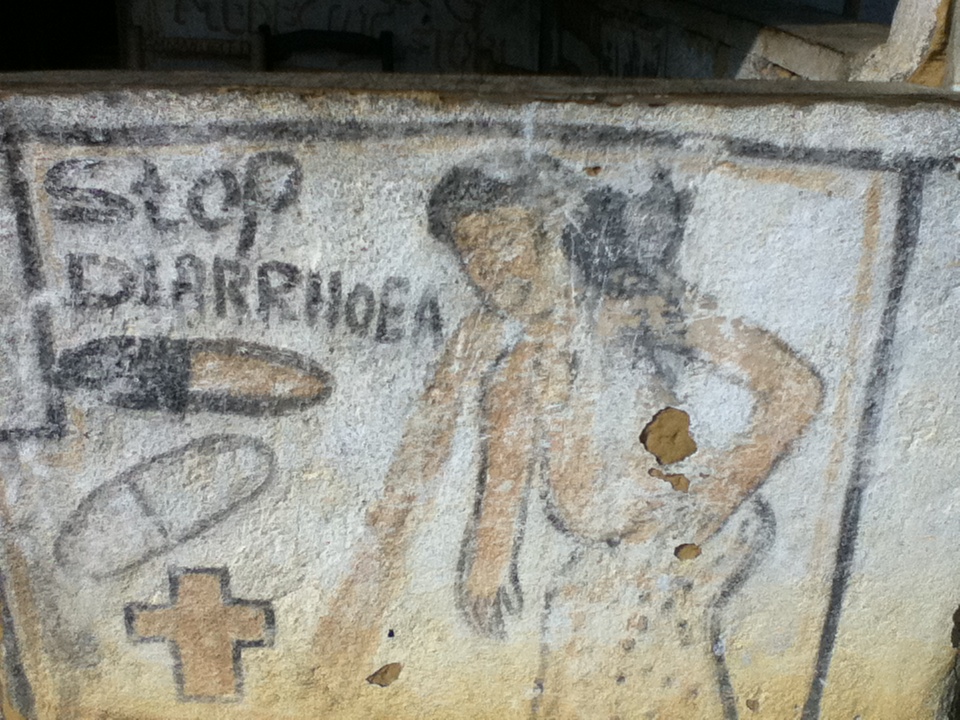
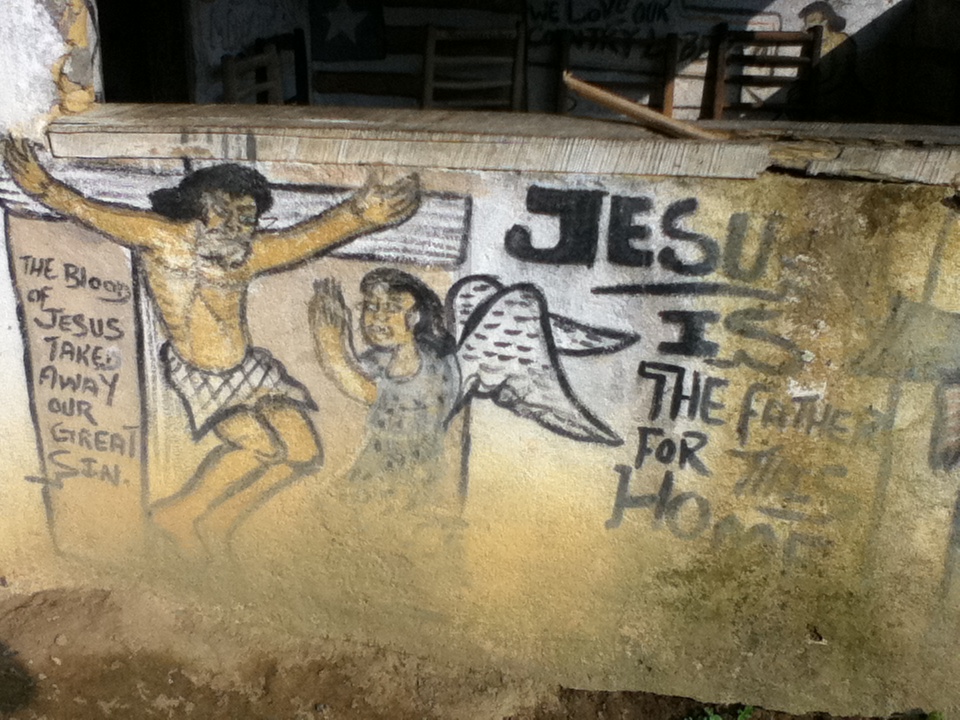
Murals And Hut Designs in Zondo


Before sharing the beautiful and interesting murals and designs I saw on the buildings in Zondo, I just want to say a few things about the amazing man who was our guide.  Arthur Crusoe is the sort of man who adopts war orphans and raises them as his own.  He is the sort of man that leaves a good paying job (by Liberian standards) in Monrovia so that he can oversee a school in rural Zondo to educate his people.  He is extremely overqualified for this job and also extremely underpaid for his work.  He shared with us stories from Zondo’s past and hopes for Zondo’s future.  Arthur is also one of the presenters that the people of Zondo picked to speak when the President of Liberia, Madame Ellen Sirleaf Johnson, visited [view here]. 

Back to the tour of Zondo…. I will let the pictures of the murals and designs speak for themselves although one of the murals involves a riddle-story that I will explain in full in a later post.


Thursday, April 26, 2012

The Spotted Man of Zondo and His Ancient Horn

Before entering Zondo I was told about the Dor-kpa (Bassa for 'lappa' or 'towel').  I wasn't told why the horn was given the peculiar name of 'lappa', but I was told that the Dor-kpa is an ancient elephant tusk horn that was captured by this village in battle more than 200 years ago.  “It was before the Independence of Liberia”, my host Floyd Morgan said.  That happened in 1847.  Heaven knows how old the horn was when it was captured.  “The Dor-kpa is very special to this village," I was told.  Supposedly many Bassa and surrounding peoples are aware of this village and know it as the place that holds the Dor-kpa, the ancient elephant tusk horn won in battle.

Floyd Morgan holding the ancient 'Dor-kpa' an elephant tusk horn.

President Sirleaf Johnson visits Zondo on April 23, 2011
(photo by Floyd Morgan)
The other thing Floyd told me about the Dor-kpa was that it was “beat” (or blown) whenever a major event happened in their community.  For example whenever a chief died or a new one was announced or as had just happened a few months before, when the President of Liberia Ellen Sirleaf Johnson visited Zondo.  In all of Liberia’s history she was the first president to ever visit this rather remote part of Liberia.  


The Next In Line to become the
'Beater of the Lappa'
I was also told that the Dor-kpa was only blown by a certain lineage of specially trained individuals and there was only one man in the community allowed to blow it.  He was currently training his son to follow in his footsteps after him as the 'Beater of the Lappa,' the only one who is allowed to blow the Dor-kpa (i.e., 'Lappa').  The last thing he told me about the horn before I arrived was that they planned on “beating the Lappa” upon our arrival to the village.  I was humbled and deeply honored.


Sure enough when we arrived we were welcomed with over 15 minutes of ancient Bassa songs accompanied by the Dor-kpa.  I have still to get these three songs translated, but the Bassa people with me told me that one of the songs was sung in ancient days for a great warrior or chief when he entered the village.  Another song was sung to us as if we were hunters returning to the village with an elephant.  It was a song of rejoicing as an elephant could feed everyone in the village for months.  The last song had something to do with the community and having each other’s back.  We were getting a royal welcome!  


As you can see from the video above the men’s bodies are painted with white spots.  This is the traditional war paint of the Bassa people and represents leopard spots.  The fact that these are warriors greeting us somehow symbolizes respect to us.  We were greatly honored and blessed to meet the wonderful people of Zondo.


The Spotted Man with The Ancient Horn Himself!