Showing posts with label Africa. Show all posts

Thursday, May 10, 2012

Willie Power Town Is Calling


Author with horn from Willie Power Town, Grand Bassa County, Liberia

During rice harvest (or rice bird) season many of the able bodied are in the rice fields either bringing in rice or keeping rice birds off the rice.  What happens if the village gets in trouble when so many are away?  How will the village be protected and helped?  Enter the horn.  As you can hear from this video these horns can be heard a long way off.  If you were working out in the fields and heard this sound you would immediately rush to the aide of your village.  So it was with great significance our family was gifted one of the horns of Willie Power town in 1985.


Road through Willie Power Town
photo by Ken Vogel
Willie Power town is more than likely named after someone named “Willie Power” as are so many villages in Liberia so named after their founders or chiefs.  It is located in the Moweh region of Grand Bassa County and like so many of the villages we have visited I can’t find it on Google maps.  This sort of reminds me of the old and sometime irreverent Graham Greene travel book on Liberia "Journey Without Maps (Penguin Classics)" to which this blog title pays homage.  (Note:  He's is not coming to Liberia with a worldview I would personally endorse.)  Much of Liberia still remains unmapped, undiscovered and beautiful beyond description. I actually hope certain people never discover this beauty as I'm sure they would try to take advantage of these generous people.  As of now I’m not sure how much, if any, of this village exists after the horrors of the Liberian Civil War, or if it can still be found even by word of mouth, but I want to share with you what they shared with us nonetheless.

Willie Power Town is surrounded by tropical forest.  Mom stands by a tree for reference
photo by Ken Vogel
Pekin in Willie Power Town
photo by Ken Vogel


Why was this horn given to us?  Here is the significance:  We were told that their village needed help and they were in great need.  Like so many places in Liberia they needed schools, clinic, clean drinking water, opportunities for commerce and enterprise.  And so we were charged with taking this horn from Willie Power Town and blowing it so others might hear of their need and come and help.  It is a call to come in from your harvesting and protect the people.  In this powerful and poignant Liberian symbolism they are crying for help.  Who will come back from the fields and answer the call?


Willie Power Town.  Notice 'Bush Girl" painted white on the left.
photo by Ken Vogel

A church building in Willie Power Town
photo by Ken Vogel
Small Pekin in Willie Power Town
photo by Ken Vogel
One of my Loma brothers has told me, “You are not even from this country and you come here to help.  Your actions should convict the Liberians in the States to come to us.”  I am not here to create feelings of guilt or manipulate anyone.  As best I can tell my actions are based on my love for the Liberians with whom I have shared life since a small child.  I consider Liberians my people and call them Old Ma, Old Pa, brother, sister, daughter, son and pekin and they in turn call me brother and son.  They gave us this horn so I have to remember my people.  If the horn of Willie Power Town calls you who might today be harvesting away from the village, perhaps in the Liberian Diaspora, that is between you and your people.  I will continue to do what I do whether anyone else might come to help and let the horn call whomever it may call.  As Jesus often said, “He who has ears, let him hear.”  Willie Power Town is calling.  Liberia is calling.


Children in a kitchen in Willie Power Town
photo by Ken Vogel

Woman 'Running Water"
Willie Power Town
photo by Ken Vogel
The Horn of Willie Power Town

Wednesday, May 9, 2012

The Robertsport Sandbar

A mangrove plant growing on the Robertsport sandbar.  Cape Mount is in the background.
On Robertsport Beach you can walk out onto a sandbar that divides the beautiful Lake Piso from the Atlantic Ocean.  At the very end of this sandbar the Atlantic and Piso converge as this 360' video shows.  (The video starts with the Atlantic Ocean and pans right revealing the Sandbar and then Lake Piso and Cape Mount as it makes a full circle...)


My descriptions of this place won't do it justice and neither will these pics but they will give you a bit of an idea of how beautiful this place is.  Standing out on the Robertsport Sandbar you are surrounded by water on all sides.  You feel like you are in a different world as you watch the waves of the Atlantic as they sometimes crash into smaller waves coming out from Lake Piso.  A perfect place to sit and just "realize".  I'll let the pics and captions do the talking for the rest of this post... Enjoy!

The Robertsport Sandbar - Atlantic Ocean to the left; Lake Piso on the right

View from the Robertsport Sandbar back towards Robertsport and Cape Mount.  

"Dependable God" Canoe.  Lake Piso is in the background

Walking back towards Robertsport on the Robertsport Sandbar

Lake Piso and Cape Mount in the background

Lake Piso


Tuesday, May 8, 2012

Palm Butter Rice Too Sweet!


A palm nut that was being munched on by a free range chicken.

There is a chant we sing in Liberia with the following words, “Palm butter rice too sweet, o yeah!  You eat it, you want some more!”  I think palm butter on rice has to be in the top ten best things to eat in the whole world.  I find it difficult to believe that there are some people who really don’t care for it, but in the world of food I find this old adage to be true:  to each his own.  And to me I’ll take palm butter please!

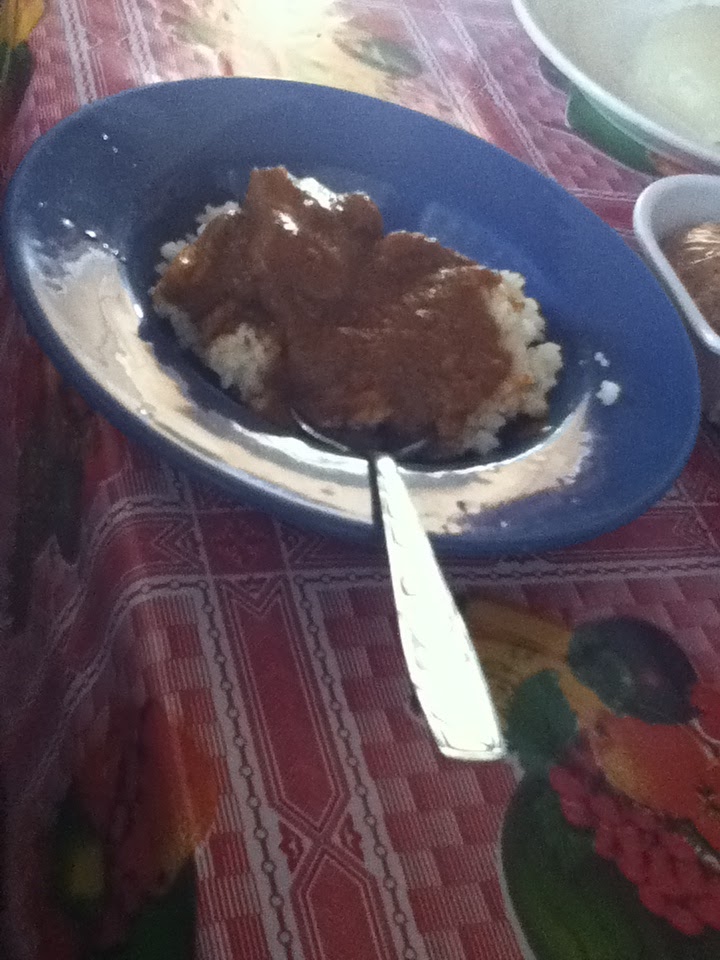
Palm Butter and chicken over rice

What is palm butter?  It is a sauce sometimes made with chicken or some other meat that is often put over rice.  The sauce itself is made from the nut of the oil palm tree.  The nuts are cut in clusters off of the tree and then the nuts are separated and placed in a hollowed out wooden mortar and pounded with a long wooden pestle.  What is left is this orangish, fatty stuff that comes off the outside of these nuts and it is from this that the thick orange palm butter sauce is made.  I’m not sure exactly how it is made, but I do know how to eat it! 

Mortar and pestle used to pound palm nuts among other things.
Compound #2 area, Grand Bassa County, Liberia
A closer look at some pounded palm nuts

There are many things that can be done with the palm nut.  You can make the butter sauce that is put over rice or Kru-style over boiled cassava.  One treat is to leave the nut whole and boil it in sugar to make what is called ‘sugar palm’.  These little snacks are delicious.  You can also open up these nuts and get at a whitish seed inside that is also good to eat.  The palm oil that is extracted from the outer part of the nuts is a dark reddish color and is great for frying food, especially fish, chicken and monkey. 

Sugar Palm
There are also many other products that are made from this nut including soaps, lotions, candles cooking oil and cleaning products.  There is a great commercial value here as well.  In fact, in 2009, Sime Darby signed a 63-year concession agreement with Liberia for 220,000 hectares of land to be developed into oil palm and rubber plantations. I drove through part of the Sime Darby plantation on the way to Robertsport in 2011 and it is quite a production.  This operation is projected to bring about 35,000 jobs to Liberia.  Now that’s a lot of palm butter!


...You eat it, you want some mor
If you ever get a chance to try some palm butter I recommend it, however the canned stuff over here just doesn't compare to the fresh stuff off the tree.  If you really want to eat palm butter, you have to eat it in Liberia and when you eat it in Liberia, don't be surprised if you spontaneously break out in song, "Palm butter rice too sweet, o yeah!..."


Saturday, May 5, 2012

How To Count To Ten In Bassa


Bassa is one of the 16 or so languages spoken inLiberia and one I have been exposed to since age 3.  One of the first things you would learn in Bassa is how to count.  Counting in Bassa usually includes not just the mouth but also the hands!  Watch the video and then I’ll explain the hand movements which can be used as a kind of sign language.


When you are counting, you start with ɖò (one) by pointing to your pinky on your left hand with your right index finger.  When you get to sÉ”̃́ (two) you point to the your left ring finger with your right index and bring the left ring finger together with your pinky.  You continue until you have all five of your digits on your left hand together at hm̀m̌ (five).  You then continue this pattern onto your right hand pinky and finally end with É“aÉ–a-bùè (ten) by placing both hands together in what looks like two hands praying.  By using these hand signals you can indicate a number to someone without even speaking (i.e. by raising and pressing together the pinky, ring & middle fingers of your left hand you will indicate the number ‘3’ to someone).

I’ve listed the Bassa numbers below from 1 – 10.  You’ll notice that there is some repetition after the number 5 as the number 6 is the word “mÉ›̀nÉ›̌ìn” + the word for “one” (ɖò) and 7 is “mÉ›̀nÉ›̌ìn” + the word for “two” (sÉ”̃́), etc.  If you learn to count past 10 you’ll notice this sort of pattern repeating.  This system of counting is based on the digits of your hand, our God-given calculator! 


One to Ten in Bassa (with rough guide to pronunciation) :
ɖò (dough) - one
sÉ”̃́ (sawe)- two
tã (tah) - three
hÄ©inyÉ› (he nyay) - four
hm̀m̌ (hmm) - five
mÉ›̀nÉ›̌ìn-ɖò (muhnain dough) - six
mÉ›̀nÉ›̌ìn-sÉ”̃́ (muhnain sawe) - seven
mÉ›̀nÉ›̌ìn-tã (muhnain tah)- eight
mÉ›̀nÉ›̌ìn-hÄ©inyÉ› (muhnain he nyay)- nine
É“aÉ–a-bùè (blah bway) - ten

For some more Bassa words check out this online Bassa dictionary by my friends at CEFL.

Friday, May 4, 2012

Pen-Pens: The New Way To Get Around

This Bike came from Ganta to Conference in Monrovia where we taught.


One thing that has definitely changed since I used to live here were the Pen-Pens (motorcycles) that now swarm the streets of Liberia.  There are still taxis and buses and bicycles but there are Pen-Pens everywhere swerving in and out of traffic making their namesake sound with their horn: "Peen Peen!".  


We mostly took automobile taxis as they seem to be more safe, but I took a moto-bike taxi several times and it was quite an adventure!  No one wears helmets.  No one obeys traffic laws.  No one stops for pedestrians.  In fact, some Pen-Pen drivers seemed to get a chuckle out of laying on their horn and startling the unsuspecting as they drive by.  There are some of those types in every society.


PROS:  You get there faster.  Can handle bad road conditions better than autos and buses.  Fresh air and "cycle therapy" with the wind in your hair and all that jazz.


CONS:  You may not get there!  Exposed to elements/opportune thieves.  Not always seen by larger vehicles.

My big Kpelle brother, Daniel K. Biah, who took me on several Pen-Pen rides through Buchanan

As with any taxi ride, you put your life in the hands of the driver.  Don't hesitate to say, "Slow down!"  Here is a brief part of one of my Pen-Pen trips through Buchanan in Grand Bassa County, Liberia.


Wednesday, May 2, 2012

An African Queen In Mourning (Part 2)

Stairwell in the TCFAC
Today we head up the stairs of the once glorious Tubman Center for African Culture in Robertsport, Liberia.  Perhaps someday she will be restored, but for now we can only imagine what once she looked like...


Going Down the Upstairs Hall


A gorgeous view from the upstairs balcony

And now back downstairs....


The Side Building


Tuesday, May 1, 2012

An African Queen in Mourning (Part 1)


Tubman Center for African Culture, Robertsport, Liberia

Our truck broke down at the top of an overview of Robertsport.  I’m kind of glad it did because it allowed us to to slow down on our whirlwind tour of the area and take it all in for a bit.  Robertsport is best seen on foot.  Before we tour this gorgeous town I want to take you inside an amazing building next to where we had broken down.  
Entranceway - Tubman Center for African Culture, Robertsport, Liberia

My Vai friend Jasper told me that it was called the Tubman Center for African Culture.  At one time it housed rare African artifacts and records that were sadly lost during the war.  Hopefully these items were simply looted and will one day be rediscovered and returned, but perhaps they are lost forever.  There is a feeling here as if the building were mourning her ravished treasures.  I seriously felt like I feel when I hear someone sobbing, but there was no sound except the whispering ocean breeze.  It was heartbreakingly beautiful.   I can still see her once great glory through the wreckage and perhaps I am not the only one…


Next time we'll explore upstairs...
  

Sunday, April 29, 2012

Liberian Riddle On A Mural


Below is written this Liberian riddle which you can also watch presented in the following video...


The Riddle...
A man has a dream that a he is being chased by a lion.  So then he climbs up a tree.  Once he is up the tree he realizes there is a snake there with him!  The snake starts running behind him with the intention of biting him with its deadly poison.  So then the man ties a rope on a branch and starts to let himself down from the tree.  Then the man looks down and below him is an alligator waiting for him in the river below!  The man looks back up and sees a rat at the top of the rope chewing on it!  So the question is what must the man do in order to escape?  


[scroll down for answer]

 |
 |
 |
V


Wake up!

Saturday, April 28, 2012

Murals And Hut Designs in Zondo


Before sharing the beautiful and interesting murals and designs I saw on the buildings in Zondo, I just want to say a few things about the amazing man who was our guide.  Arthur Crusoe is the sort of man who adopts war orphans and raises them as his own.  He is the sort of man that leaves a good paying job (by Liberian standards) in Monrovia so that he can oversee a school in rural Zondo to educate his people.  He is extremely overqualified for this job and also extremely underpaid for his work.  He shared with us stories from Zondo’s past and hopes for Zondo’s future.  Arthur is also one of the presenters that the people of Zondo picked to speak when the President of Liberia, Madame Ellen Sirleaf Johnson, visited [view here]. 

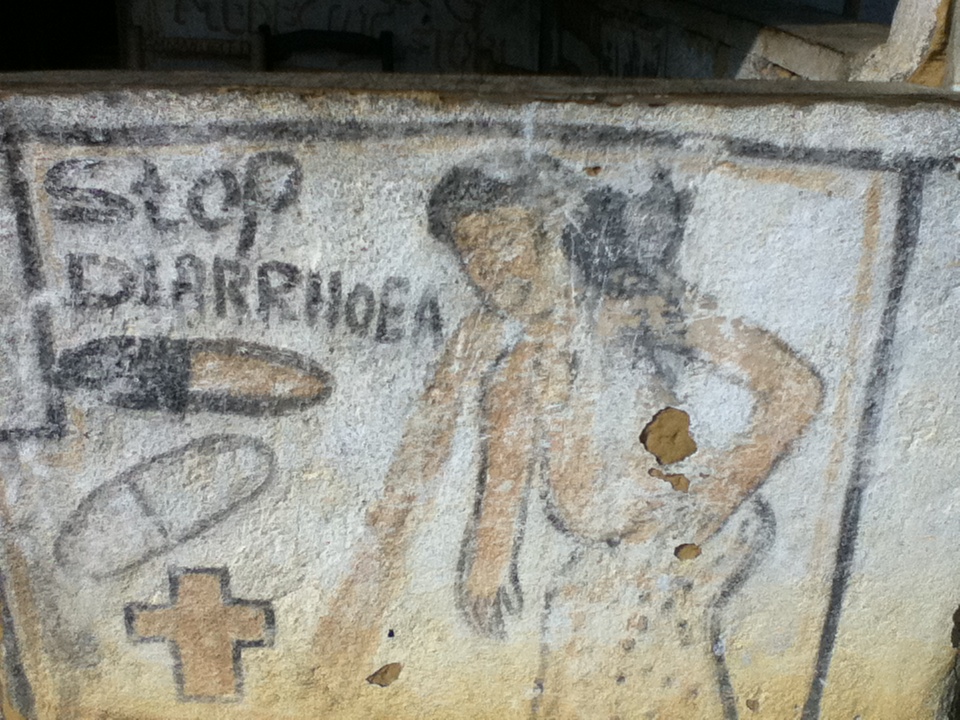
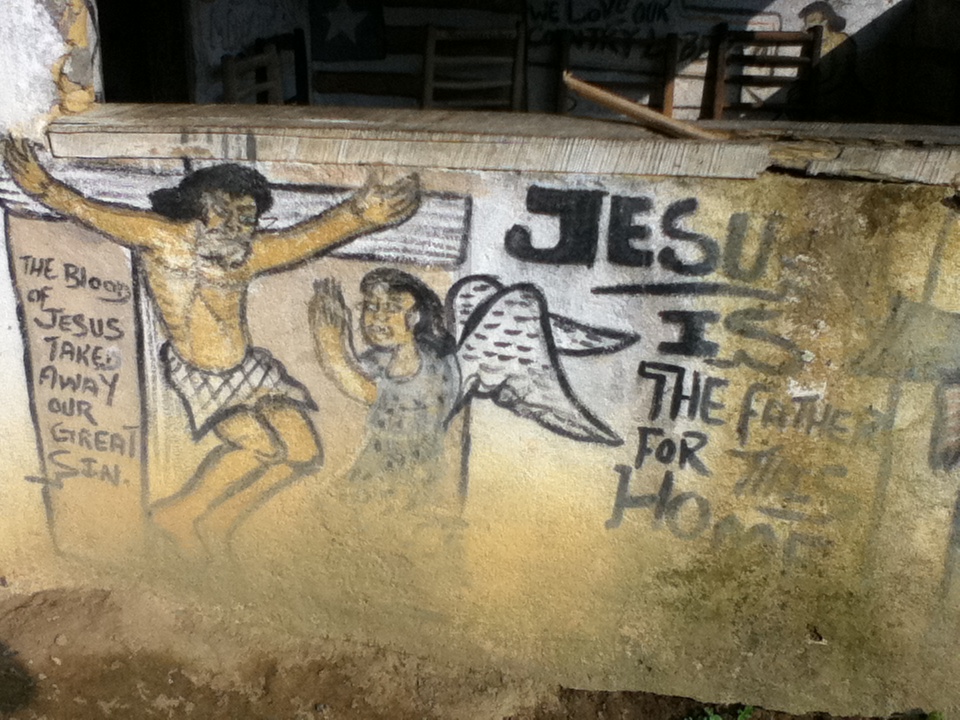
Back to the tour of Zondo…. I will let the pictures of the murals and designs speak for themselves although one of the murals involves a riddle-story that I will explain in full in a later post.