Tuesday, May 8, 2012

Palm Butter Rice Too Sweet!


A palm nut that was being munched on by a free range chicken.

There is a chant we sing in Liberia with the following words, “Palm butter rice too sweet, o yeah!  You eat it, you want some more!”  I think palm butter on rice has to be in the top ten best things to eat in the whole world.  I find it difficult to believe that there are some people who really don’t care for it, but in the world of food I find this old adage to be true:  to each his own.  And to me I’ll take palm butter please!

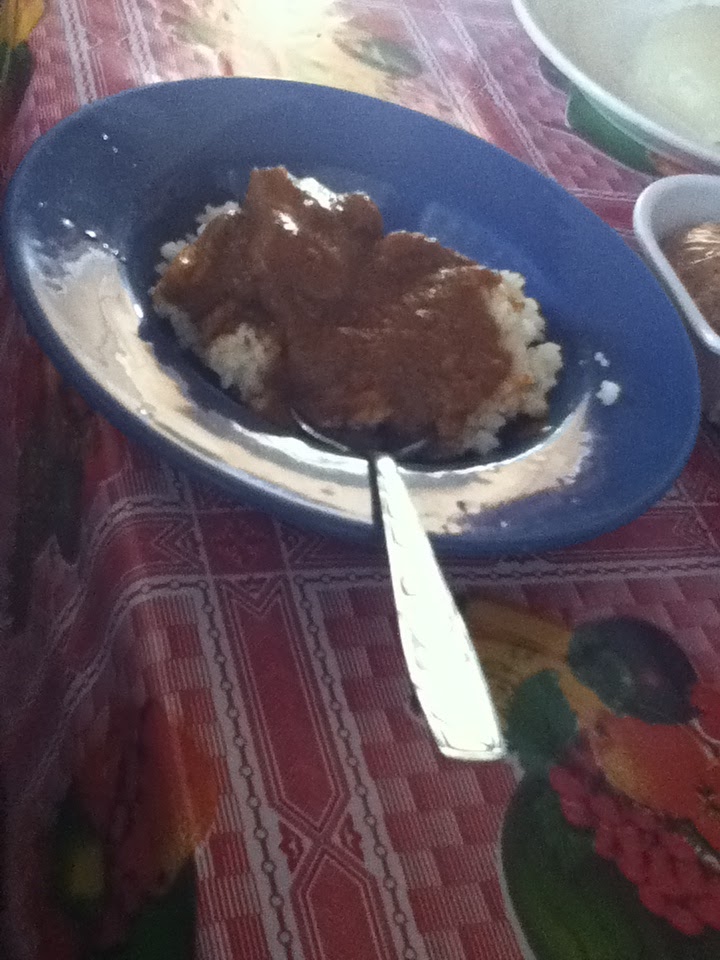
Palm Butter and chicken over rice

What is palm butter?  It is a sauce sometimes made with chicken or some other meat that is often put over rice.  The sauce itself is made from the nut of the oil palm tree.  The nuts are cut in clusters off of the tree and then the nuts are separated and placed in a hollowed out wooden mortar and pounded with a long wooden pestle.  What is left is this orangish, fatty stuff that comes off the outside of these nuts and it is from this that the thick orange palm butter sauce is made.  I’m not sure exactly how it is made, but I do know how to eat it! 

Mortar and pestle used to pound palm nuts among other things.
Compound #2 area, Grand Bassa County, Liberia
A closer look at some pounded palm nuts

There are many things that can be done with the palm nut.  You can make the butter sauce that is put over rice or Kru-style over boiled cassava.  One treat is to leave the nut whole and boil it in sugar to make what is called ‘sugar palm’.  These little snacks are delicious.  You can also open up these nuts and get at a whitish seed inside that is also good to eat.  The palm oil that is extracted from the outer part of the nuts is a dark reddish color and is great for frying food, especially fish, chicken and monkey. 

Sugar Palm
There are also many other products that are made from this nut including soaps, lotions, candles cooking oil and cleaning products.  There is a great commercial value here as well.  In fact, in 2009, Sime Darby signed a 63-year concession agreement with Liberia for 220,000 hectares of land to be developed into oil palm and rubber plantations. I drove through part of the Sime Darby plantation on the way to Robertsport in 2011 and it is quite a production.  This operation is projected to bring about 35,000 jobs to Liberia.  Now that’s a lot of palm butter!


...You eat it, you want some mor
If you ever get a chance to try some palm butter I recommend it, however the canned stuff over here just doesn't compare to the fresh stuff off the tree.  If you really want to eat palm butter, you have to eat it in Liberia and when you eat it in Liberia, don't be surprised if you spontaneously break out in song, "Palm butter rice too sweet, o yeah!..."


Monday, May 7, 2012

What’s Up With The Liberian Flag?


Flag of the Republic of Liberia


A US citizen will immediately recognize that the Liberian flag looks an awful lot like our flag.  Why?  The reason is that Liberia was an African colony founded by US born individuals.  There were actually many US backed colonies with US sounding names like Mississippi-In-Africa and the Republic of Maryland.  You see, what happened was that many in the US population at that time (early 1800’s) were unsure and/or uncomfortable with how to integrate the “free people of color” (what free African Americans were called at that time).   So some US citizens founded the ACS (American Colonization Society) with the intention of sending these free people of color ‘back to Africa’.  I don’t know of any US schools that teach this in history class for whatever reason, but they should I think!

Old Stars and Stripes
So the short answer to the question about the flag is that freed slaves, born in the US, founded colonies in Africa and once these colonies organized into the Republic of Liberia in 1847 they adopted a flag like the flag of their country of origin. 

Today this flag is better known (at least in the Maritime Industry) for another reason:  a flag of convenience. You will often see a Liberian flag flying over a ship because the regulations and taxes are much less than most other ports of registry.    In fact, the tiny country of Liberia at one time held the largest registry of ships in the world!   Even to this day, the small nations of Liberia, Panama and Marshall Islands account for 40% of the world’s entire fleet.  This US-inspired flag now brings in much of Liberia’s revenue and the reason for this use of the Liberian flag also had US origins.

The Amoco Cadiz was a Liberian flagged ship that ran aground in 16 March 1978
and created the largest oil spill in history up to that date.  This event led to laws
giving port states more authority in inspected ships in their port.

Early in WWII Liberia became a key place to transport troops.  Troops would avoid German U-boats by going south from the US to Brazil and east over to Liberia where they would set out to engage the enemy in Northern Africa and ultimately in Europe.  Liberia was also a major contributor of rubber for the war effort as the home of the world’s largest rubber plantation: Firestone.  During this time frame, the US Secretary of State, Edward Stettinius, who was also a friend of Liberian president William Tubman , came up with an idea to bring revenue into Liberia.  As an astute businessman (past president of Diamond Match Company) he helped create the ‘Liberia Company’ in 1947 which in turn brought funds to Liberia and US financiers by registering ships under the Liberian flag. 

So perhaps the next time you take a cruise or see a ship in port flying a flag that looks an awful lot like ours but with only one star --- you’ll know a little of the inside scoop.  

Saturday, May 5, 2012

How To Count To Ten In Bassa


Bassa is one of the 16 or so languages spoken inLiberia and one I have been exposed to since age 3.  One of the first things you would learn in Bassa is how to count.  Counting in Bassa usually includes not just the mouth but also the hands!  Watch the video and then I’ll explain the hand movements which can be used as a kind of sign language.


When you are counting, you start with ɖò (one) by pointing to your pinky on your left hand with your right index finger.  When you get to sɔ̃́ (two) you point to the your left ring finger with your right index and bring the left ring finger together with your pinky.  You continue until you have all five of your digits on your left hand together at hm̀m̌ (five).  You then continue this pattern onto your right hand pinky and finally end with ɓaɖa-bùè (ten) by placing both hands together in what looks like two hands praying.  By using these hand signals you can indicate a number to someone without even speaking (i.e. by raising and pressing together the pinky, ring & middle fingers of your left hand you will indicate the number ‘3’ to someone).

I’ve listed the Bassa numbers below from 1 – 10.  You’ll notice that there is some repetition after the number 5 as the number 6 is the word “mɛ̀nɛ̌ìn” + the word for “one” (ɖò) and 7 is “mɛ̀nɛ̌ìn” + the word for “two” (sɔ̃́), etc.  If you learn to count past 10 you’ll notice this sort of pattern repeating.  This system of counting is based on the digits of your hand, our God-given calculator! 


One to Ten in Bassa (with rough guide to pronunciation) :
ɖò (dough) - one
sɔ̃́ (sawe)- two
(tah) - three
hĩinyɛ (he nyay) - four
hm̀m̌ (hmm) - five
mɛ̀nɛ̌ìn-ɖò (muhnain dough) - six
mɛ̀nɛ̌ìn-sɔ̃́ (muhnain sawe) - seven
mɛ̀nɛ̌ìn-tã (muhnain tah)- eight
mɛ̀nɛ̌ìn-hĩinyɛ (muhnain he nyay)- nine
ɓaɖa-bùè (blah bway) - ten

For some more Bassa words check out this online Bassa dictionary by my friends at CEFL.